

Pest control SEO is the work that puts a pest control company on Google Maps when someone nearby has termites, rats or bed bugs and searches for help. A homeowner in a suburb eight miles from your yard types "pest control near me" at 7am on a Saturday. Google shows a map and three companies. One of them gets the call, the inspection and, if the technician does the job well, the yearly contract. This guide is about being one of those three, not just on your own street but across every suburb your trucks drive to.
We build ranking tools for local businesses and run link campaigns for them, including 23 pest control companies so far. Most of what follows is measured: real rank grids across a whole metro area, real review pace against nearby rivals, a real check of whether AI assistants name a pest company, and the totals from 857 links built for pest control companies. It ends with a step-by-step 90-day walkthrough, grid by grid. All keyword figures are US search data from October 2026.
One thing before the detail. Your customers search in spring and summer. Google decides who they see based on what you do this winter. If you are reading this in October or November, you are on time.
What is pest control SEO?
Pest control SEO is the set of changes that make a pest control company show up on Google Maps and in search results when someone nearby looks for an exterminator, a termite inspection or treatment for a specific pest, first in the map pack and then in the website results below it. It has three parts: the Google Business Profile, the website, and the signals around both, which are reviews, listings on other sites and links from them.
The map pack is the part that pays. For "pest control near me", Google shows a map and three companies before any website. Those three get most of the calls. A company sitting tenth in the website results underneath gets almost nothing. So this guide spends more time on the map than on anything else, and it treats the map as a place with dozens of suburbs, not a single rank.
Why the timing matters more in pest control than in any other trade
Pest control has a season, and so does the search for help with marketing. The two are opposite. Customer searches for "pest control" climb from February, peak from April to July, and fall away by October. Owner searches for "pest control seo" do the reverse: they are highest in October and November, when the phones go quiet and there is time to think, and lowest in summer when nobody has a spare hour.
Customers search in spring and summer. Owners search for help in autumn.
That gap is the whole argument for starting now. Links take weeks to be found by Google, reviews take months to build, and a new page needs time to earn its place. Work started in October is in place for March. Work started in April competes against companies that did theirs in October. The 90-day plan at the end of this guide is timed to that calendar.
Where your pest control company ranks right now, suburb by suburb
Most ranking reports give you one number: "you rank 4th for pest control". That number is measured from one spot, usually your own address, and it hides the problem. A pest control company is a service-area business. The yard is in one place, the jobs are everywhere. Google ranks you differently at every point a customer searches from, and the further from the yard, the worse it gets.
A rank grid measures that. It searches the same keyword from dozens of points across your area and shows the rank at each one. Here is a real scan of a service-area pest control company in the Pacific Northwest, 49 points one mile apart, September 2026. The name is hidden; everything else is as Google returned it.
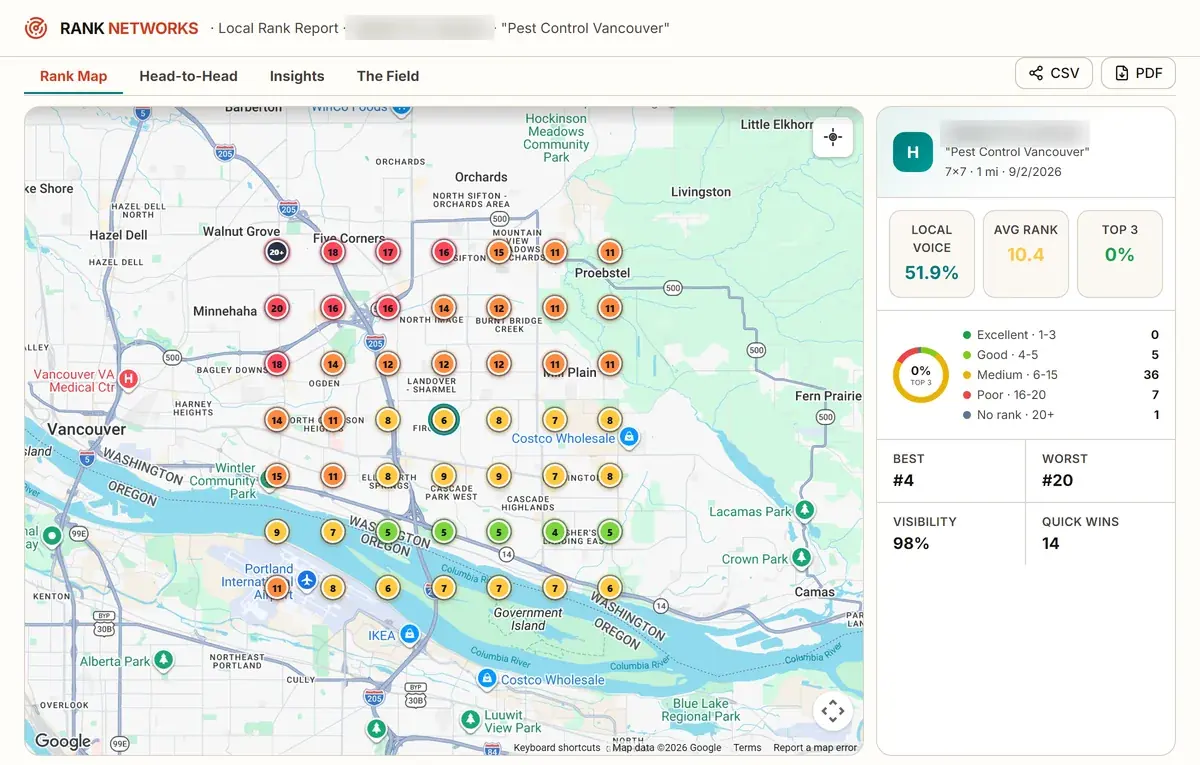
Read it like a map of where the phone rings. In the south, this company is a strong second choice. Across the whole northern half, where more than half its service area sits, it is on page two. Nobody scrolls to 14th on a phone. Local voice 51.9% and top 3 at 0 of 49 points is the honest summary. Local voice is the Grid Ranker's single score for how much of the map you own: 100 means first at every point, 0 means absent everywhere. The owner thought the company "ranked well", because at the yard it did.
The pattern we see in almost every pest control scan
Good near the yard. Page two within three miles. Invisible beyond that, in exactly the suburbs the trucks spend the day in. Hidden addresses make it worse, because Google has less to anchor the business to. The companies winning the whole metro area are the ones with the most reviews, the most listings and the most links that mention those suburbs, not the ones with the best technicians.
Run your own before you change anything. The Google Maps rank tracker scans a grid like the one above for your company and your keyword. The rest of this guide tells you what to do with what it shows.
How Google ranks pest control companies on Maps
Google names three local ranking factors on its own help page: relevance, distance and prominence. In pest control terms they work like this.
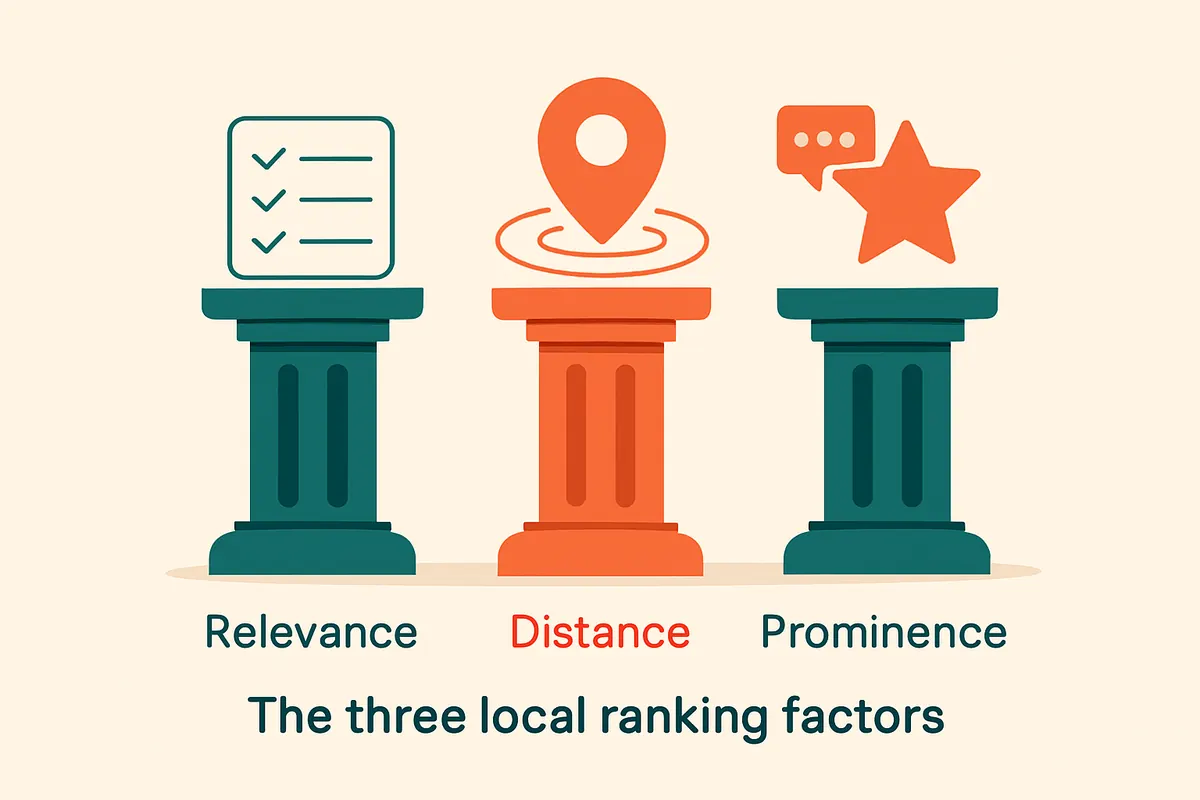
Relevance is how well your business matches the search. Your primary category, the services listed on your profile, the pages on your website and even the words in your reviews all feed it. A company with "Pest control service" as its category, a service entry for termite inspections and a real termite page on its site is more relevant for "termite inspection" than one with a homepage and a phone number.
Distance is how far the searcher is from your location. For a service-area business with a hidden address, Google still uses a location, and it still favours businesses closer to the searcher. You cannot move the yard. That is why the two factors you can control have to carry the suburbs further out.
Prominence is how well known the business is: review count and pace, how often the business is mentioned and linked on other sites, and whether its details match everywhere. Prominence is what lets a company rank at the edge of its area where distance is against it.
Start with an audit, not a guess
Before fixing anything, find out where the company stands on all three factors. A Google Business Profile audit checks the profile, compares reviews with the companies above you, crawls the website, checks listings and, most useful of all, scans the map on a grid. Our 21-point audit checklist covers every item by hand; the audit tool runs the same checks in a few minutes. For this guide we audited a small pest control business in Australia. This business is not a client and its name is hidden. It shows what a typical one-truck company looks like before any SEO work.
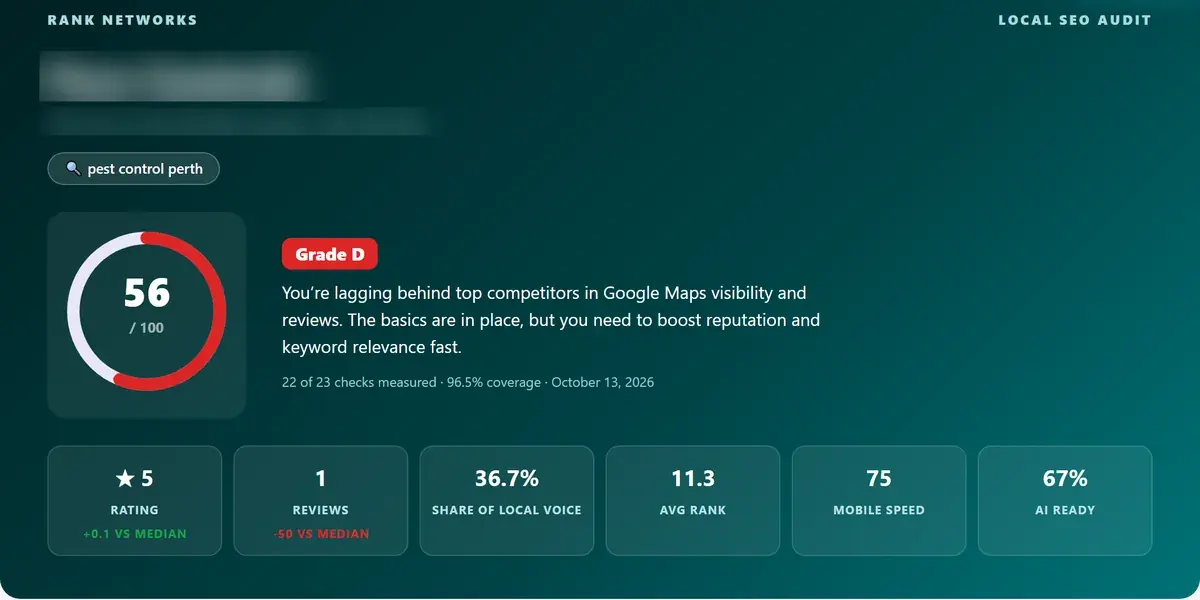
Look at the cover. A 5-star rating and a score of 56 out of 100. The rating is perfect and it does not matter, because it rests on a single review. Share of local voice is 36.7%, so the company owns about a third of its map. The audit grades the whole picture, not the star rating, which is why owners are often surprised by it.
![Audit visibility section for "pest control [city]" showing the business in the top 3 at 1 of 49 points, average rank 13.7 and a map of 49 ranks with grey points to the north](/blog/pest-control/audit-visibility-pest-control.webp)
Every finding becomes a line on a roadmap, ordered by how much it should move the rankings. For pest control, three sections matter most: visibility across the area, review pace, and the service and category gaps. The next sections work through each.
Your Google Business Profile for pest control
Google ranks the profile before the website, so the profile comes first. For a pest control company there are five settings that do most of the work, in this order.
Categories
The primary category is Pest control service. That is the one Google matches first for every pest search, and changing it later can put the profile under review for a few days, so set it once. Add secondary categories only for things you really do and only if Google offers them in your country: animal or wildlife control if you handle possums, raccoons or birds, lawn or termite work if you offer it. Do not add categories to chase keywords. Individual pests go in the services list, not the categories.
Service areas, and the hidden address
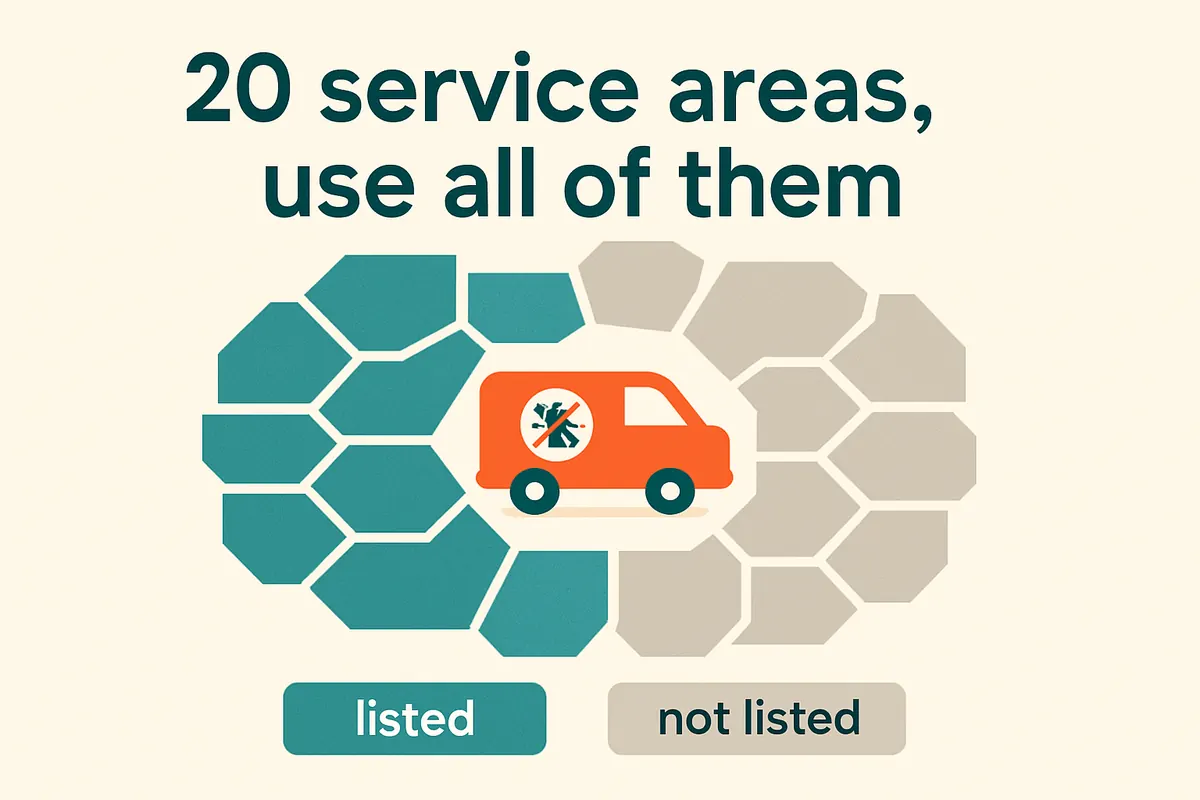
Most pest control companies hide their address, and that is fine; Google requires it if customers do not visit you. What matters is the service-area list underneath. You can set up to 20 towns, suburbs or postcodes, and Google uses them as a hint about where you should show up. List the suburbs your trucks actually cover, named the way customers name them, with the furthest ones included. A company that lists only its home city and nothing else has told Google nothing about the other 19 suburbs it serves. Google's service-area business page covers the rules.
Services: one entry per pest and per treatment
Add every pest and every treatment as its own service entry with a short description: termite inspection, termite treatment, rodent control, bed bug treatment, cockroach treatment, ant control, wasp nest removal, mosquito control, spider treatment, commercial pest control, annual pest plans. These are the words customers search and the audit's service-gap section lists the ones you are missing. One line each is enough.
Photos of the work, not stock photos
Technicians in uniform, the trucks, a termite inspection in progress, a sealed entry point, before and after a wasp nest. Twenty real photos beat two hundred stock ones, and Google reads the upload dates, so add a few each month. Customers also look at them before they call, because they are letting a stranger into their house.
Hours, emergency availability and the booking link
"Emergency pest control" has a cost per click of $48.83, the highest in the table below, because the person searching it has rats in the kitchen tonight. If you answer the phone after hours, say so in the hours and in the description. Add your appointment or contact link if you take bookings online, and add seasonal posts: termite season, wasp season, rodent season as the weather turns. The checklist covers the rest of the profile.
Reviews: pace beats total
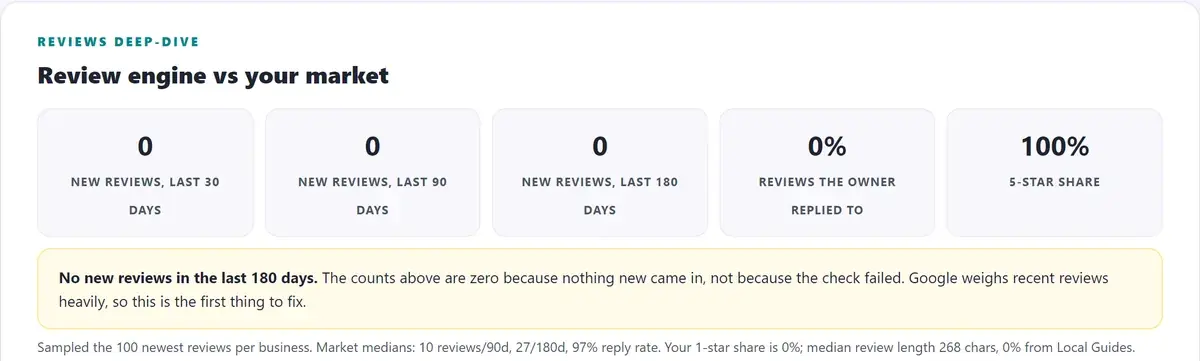
Every guide says "get more reviews". The number Google actually responds to is the pace: how many new reviews you get a month compared with the companies next to you on the map. A pest company with 300 reviews and none this year loses to one with 120 and four a month. Here is a real readout for the audited company against its three nearest rivals, October 2026.
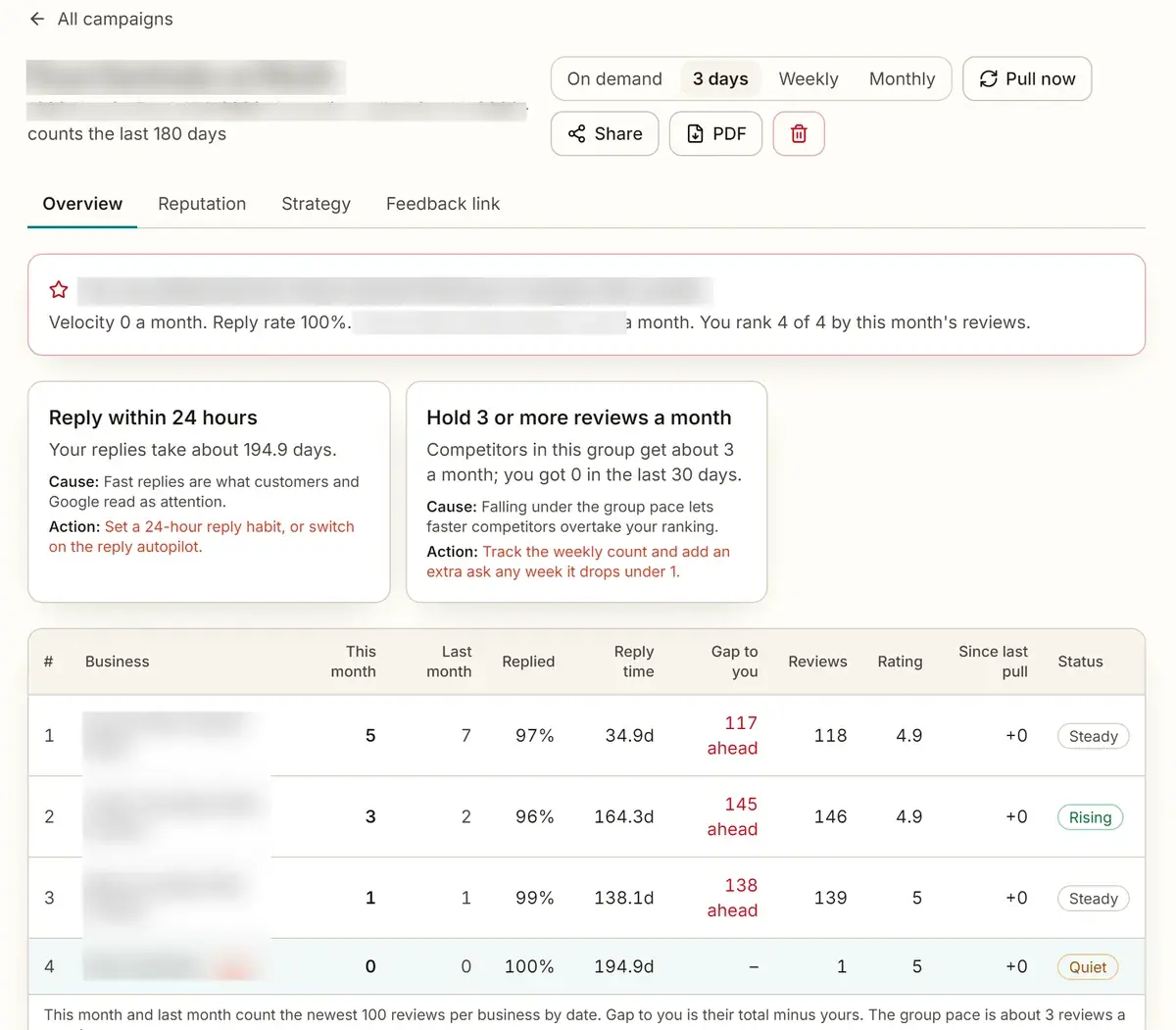
Three rules, in order of return. Ask after every job, the same day. A text from the technician with the review link before the truck leaves the driveway is the single highest-return item in this guide. Expect one customer in five to leave a review if you ask every time. Our review link generator makes the short link and a QR code for the invoice. In BrightLocal's consumer review survey, most people say reviews decide which local business they pick, and for a stranger entering the house that goes double.
Reply to every review within a day, and name the pest and the suburb. "Thanks for having us out to deal with the rats in your roof in [suburb]" does two jobs: it shows the next reader you pay attention, and it adds the pest and the suburb to your profile's text. Keep it short and never argue in public with a bad review; reply once, offer a phone call, and fix it offline. Our review reply writer drafts replies in this shape.
Never buy reviews or filter who you ask. Google removes paid reviews and can suspend a profile for them, and a suspended profile loses most of its calls for weeks. Asking every customer is fine. Asking only the happy ones through a survey first is against Google's rules.
Pest control keywords, by season
These are the pest control searches with the most US volume, with the price advertisers pay per click and the month each one peaks. The cost per click tells you which searches turn into jobs; the peak month tells you when the page and the profile entry for each pest need to be ready.
| Search | US searches / month | Cost per click | Peak month |
|---|---|---|---|
| pest control | 201,000 | $29.65 | September |
| bed bug treatment | 201,000 | $10.27 | May |
| pest control near me | 165,000 | $31.29 | September |
| cockroach exterminator | 165,000 | $15.52 | August |
| bed bug exterminator | 110,000 | $24.70 | June |
| exterminator near me | 90,500 | $36.60 | September |
| termite control | 90,500 | $26.43 | May |
| termite inspection | 60,500 | $29.56 | May |
| rodent control | 40,500 | $25.46 | September |
| wasp nest removal | 40,500 | $28.14 | August |
| mosquito control | 40,500 | $7.91 | August |
| ant exterminator | 18,100 | $31.16 | August |
| emergency pest control | 2,400 | $48.83 | July |
US search volume, cost per click and peak month over the last 12 months, pulled October 17, 2026. Every one of these searches shows a map pack.
Two things stand out. "Pest control" and "pest control near me" together get over 360,000 searches a month and both peak in September, later than the trade itself, because late summer is when people finally call about the problem they lived with all season. And the pest-specific searches have their own calendar: termites and bed bugs in May and June, wasps, ants and cockroaches in August, rodents in September as they come indoors. A company that ranks for "pest control near me" but has no termite page misses the May rush, which has the highest-value jobs of the year.

Track three to five on a grid every month: "pest control near me", your emergency keyword, and the two or three pests that bring your best jobs. Ignore the rest.
The website: one page per pest, one per suburb
The typical pest control website has a homepage, a services page with one line per pest, and a contact form. That gives Google no reason to rank it for "termite inspection", because there is no page about termite inspections. The fix is the same structure that works for roofers and dentists.
One page per pest and treatment
Termites, rodents, bed bugs, cockroaches, ants, wasps, mosquitoes, spiders, commercial contracts and annual plans each get a page. Each one covers what the treatment involves, what it costs or how the price is set, how long it takes, what the customer needs to do before and after, and two or three real jobs with the suburb named. The niche blog links in the next section point at these pages. Give each page its own title and description; the meta tag generator writes both from the page text.
Real suburb pages, not twenty copies
For a service-area business, the suburb page is the one that moves the outer edge of the grid. One honest page per cluster of suburbs you serve: the pests common to that area, jobs you have done there, how fast you can get there, and reviews from customers who live there. The suburb blog links below point at these. Do not publish twenty pages that differ only in the suburb name; Google and customers both read that as spam, and the audit flags it.
Tell Google it is a pest control company
Structured data is a short block of code that describes the business in Google's own vocabulary. Use the LocalBusiness type, with the exact name and phone from the profile, the service areas as areaServed, the opening hours, and a sameAs link to the Google listing. It does not rank you on its own, but it makes the website, the profile and the listings agree, and AI assistants read it. Google's local business markup guide has the example.
Speed and mobile
Most pest searches happen on a phone, often outside, often in a hurry. A page that takes four seconds to load loses the call to the next company. Check the mobile score in the audit and fix the images first; it is usually the images. The free tools page has a speed check.
Citations, niche blogs and suburb blogs: the three kinds of links
Links build prominence, which is what carries you past the distance factor. We build three kinds, and each does a different job.
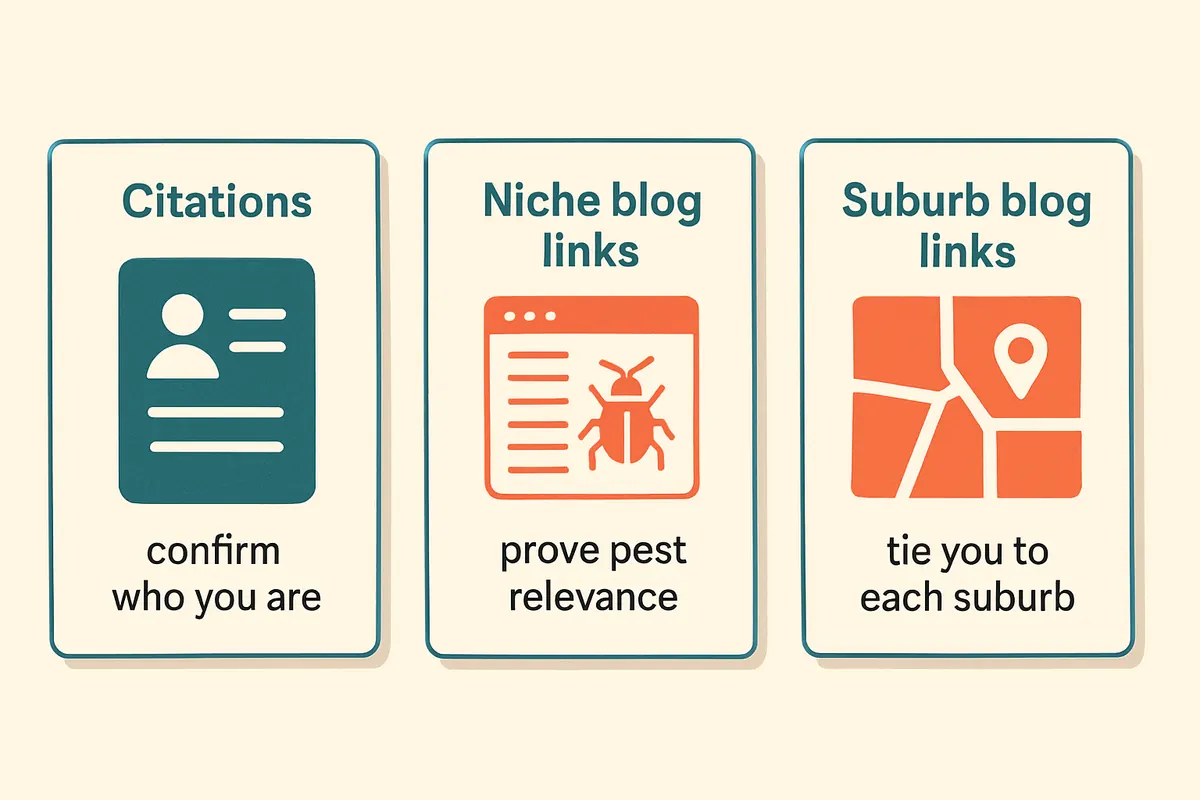
Citations are listings of your name, phone and service area on directories, map platforms and local business sites. They carry little link value on their own. Their job is to confirm, over and over, that your business exists, serves those suburbs and uses that phone number. For pest control the list is Google, Bing Places and Apple Business Connect first, then Yelp, Facebook, Nextdoor and the big home-service directories, then the pest industry sites and any state or national pest management association you belong to. Fix the wrong ones before adding new ones: an old phone number on a directory undoes the rest.
Niche blog links are articles on pest, home and property sites that link to a specific pest page. An article about telling termite damage from water damage that links to your termite inspection page is a relevance signal: a pest site treats your page as a reference.
Suburb blog links, which we call city blogs in the campaign tools, are articles on sites about your metro area and its suburbs, each linking to a suburb page. These are the links that tie you to the places where the grid shows 15 or 20, which for a pest company is most of the map.
Spread them out, vary the wording, and point them at the right pages. Thirty links a month across the three kinds is a steady pace for one company; three hundred in a week looks like what it is.
What our pest control campaigns delivered
These are the real totals from pest control companies that have run link campaigns on the platform, as of October 17, 2026. We do not name them; most are clients of our agency partners.
Pest control companies
23
US and Australia, 38 campaigns between May and September 2026
Links posted
857
223 citations, 310 niche blog links, 324 suburb blog links, across 462 publishing sites
Still live
96%
826 of 857 links live and passing value when checked
Found in Google
76%
Of 834 links checked: citations 90%, niche blogs 82%, suburb blogs 60%
Two honest notes. The indexing split matters more than the blended number: citations and niche blog links are found by Google at 90% and 82%, suburb blog links at 60%, because they sit on smaller local sites that Google crawls slowly. If you buy links for a pest company, ask for that split. And links are the slowest of the three factors to show: the companies above were scanned for links, not rankings, for most of the period.
A Texas pest control company, one week apart: real scans
Before the links
Sept 1, 2026 · average rank 4.2
After 61 live links
Sept 8, 2026 · average rank 3.7
Where we do have scans around a campaign, the move is real and modest. The Texas company above went from an average rank of 4.2 to 3.7 across 49 points in the week after its first 61 links went live, and held there for the next six weeks. A company in Virginia that has had 340 links built holds 1st or 2nd at every one of 25 points for five pest keywords, though it was already strong before we started, so we do not claim that one. The walkthrough below shows what a full 90-day programme looks like on a grid; it is an illustration and says so.
Ranking results: coming in the next update
We have put the Pacific Northwest company from the grid above on a scheduled monthly scan. The 30 and 60 day results will be added to this post as they come in, real and unedited. Until then the walkthrough below is illustrative.
Walkthrough: a pest control company's map from day 0 to day 90
Illustrative campaign. Day 0 is the real Pacific Northwest scan from August 2026; days 30 to 90 are a projection of how the campaign described above typically moves a grid, not measured client results.
Everything above is the background. Here it is step by step: one service-area pest control company, one metro area, the profile fixed in week one, 30 links a month for three months, and the same 49 points scanned every 30 days. Watch the southern half of the map, not the yard.
Visibility
100%
100%
Day 0 to day 90
Local voice
58.7%
86.6%
Day 0 to day 90
Top 3 points
2 of 49
29 of 49
Day 0 to day 90
Not ranking
0 points
0 points
Day 0 to day 90
"pest control [city]": the same 49 points, every 30 days
IllustrativeDay 0
Week 1
Before any work
- Visibility
- 100%
- Local voice
- 58.7%
- Top 3 points
- 2
- Not ranking
- 0
Day 30
Week 5
After profile fixes, citations + niche blogs
- Visibility
- 100%
- Local voice
- 65.6%
- Top 3 points
- 7
- Not ranking
- 0
Day 60
Week 9
After niche + suburb blogs
- Visibility
- 100%
- Local voice
- 76.1%
- Top 3 points
- 16
- Not ranking
- 0
Day 90
Week 13
After citations + suburb blogs
- Visibility
- 100%
- Local voice
- 86.6%
- Top 3 points
- 29
- Not ranking
- 0
Before: where the company was losing jobs
The business
Illustrative- Business
- Residential pest control, 4 trucks, one yard, address hidden on Google
- Market
- One metro area of about 20 suburbs. Every link and page targets that area only
- Starting reviews
- 86 reviews at 4.8
- Leaders in the area
- Over 3,000 reviews each at the two national franchises, about 500 at the strongest local rival
- Website
- Homepage and one services page, no page per pest, no suburb pages
- Tracked search
- "pest control [city]", 7 by 7 grid, points 1 mile apart
On paper this company was fine. A 4.8 rating, a complete-looking profile, 2nd at its own yard. Ask the owner and they would say they "ranked well on Google". Then the first grid came back: top 3 at 2 of 49 points, and 11th to 20th across the whole southern half of the area, where the trucks spend most of the week. A family in those suburbs searching "pest control [city]" would scroll past twelve companies before reaching this one.
The day 0 scan gave three problems to fix, in this order:
1. The profile said almost nothing about where it worked. Hidden address, one service area set, six services listed out of the eleven it offered, and an "Exterminator" style name on two directories from years ago.
2. The southern suburbs were page two. The bottom two rows of the grid averaged 13th. Nothing on the website or anywhere online tied the company to those suburbs.
3. A review pace gap. The two national franchises in the area have over 3,000 reviews each and the strongest local rival about 500, against this company's 86. Links alone would not close that, so the review text went out from day 1.
The 90-day action plan: profile, citations, niche blogs, suburb blogs
The plan was the profile fixes in week one, then 30 links a month, 90 in total, split evenly across the three link types. Each month paired two types so the work built on the month before. One yard, one metro area: every citation, every suburb article and every suburb page targets that area only.
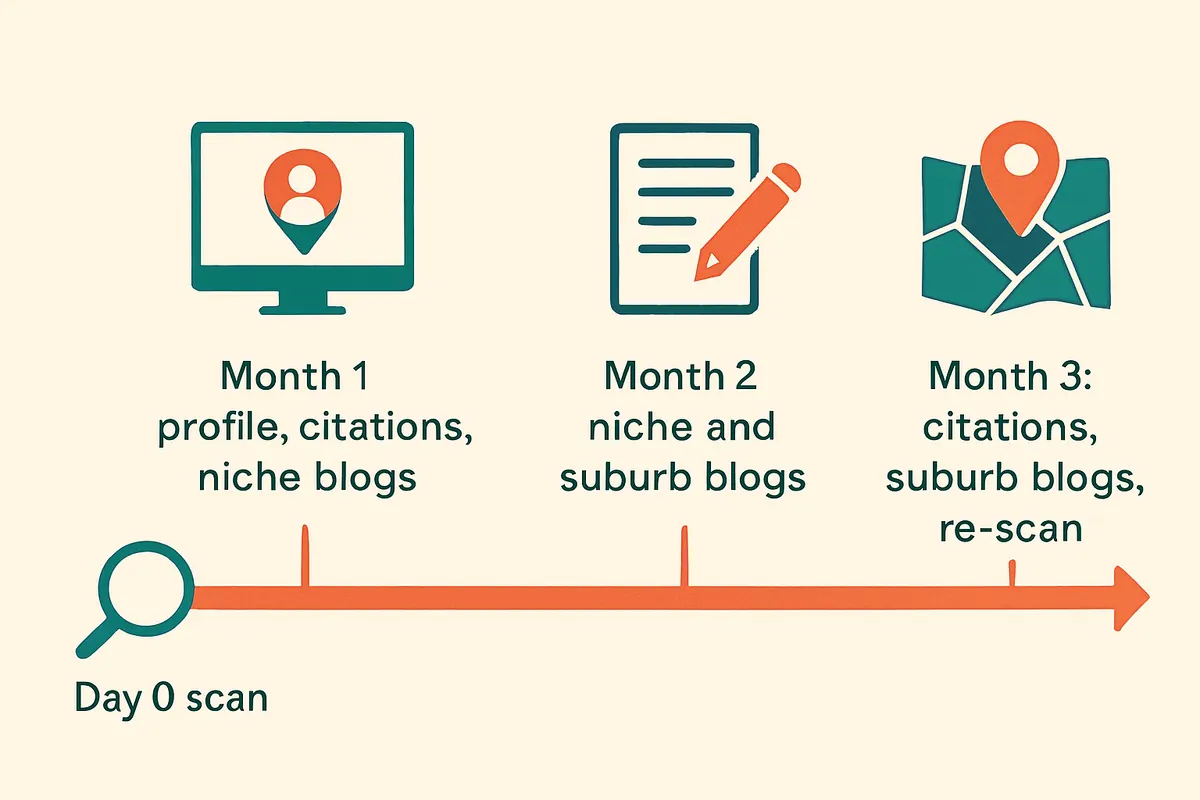
The 90-day action plan: 30 links a month, 90 in total
IllustrativeMonth 1 · Days 1 to 30
Profile fixes, citations + niche blogs
Make the profile and listings consistent and prove pest control relevance
- Primary category set to Pest control service, one service entry per pest and treatment, 20 service areas matched to the suburbs the trucks cover
- 15 citations on home-service, pest and map directories, all with the exact same name, phone and service area
- 15 niche blog articles on pest, home and property sites
- Niche links to the termite page (5), the rodent page (5) and the general pest control page (5)
- Review link texted after every completed job
Links point at: Homepage and the three main pest pages
What moved: 43 of 49 points improved. The suburbs within a mile moved most, and top 3 went from 2 points to 7.
Month 2 · Days 31 to 60
Niche blogs + suburb blogs
Keep building relevance and tie the company to the suburbs it serves
- 15 more niche articles, to bed bug (5), mosquito (5) and termite (5) pages
- 15 suburb articles on sites about the metro area, weighted to the southern suburbs the day 0 scan flagged
- One real page per suburb cluster on the website, with jobs done there and the pests common to it
- Link wording mixed: company name, name plus suburb, plain phrases
Links point at: Pest pages and the new suburb pages
What moved: The southern rows moved from 10 to 20 into 5 to 15. Top 3 points went from 7 to 16.
Month 3 · Days 61 to 90
Citations + suburb blogs
Win the far edge of the service area
- 15 more citations on city directories, community sites and trade associations
- 15 more suburb articles on sites about the far southern and western suburbs
- Topics covering the suburbs at the edge of the grid
- Each article links to the matching suburb page or the rodent page
Links point at: Suburb pages and the rodent page
What moved: The outer edge. Its average went from 7.0 to 4.5, and every point reached the top 10.
Month 1: profile fixes, 15 citations and 15 niche blogs (days 1 to 30)
Week one was the profile: primary category confirmed as Pest control service, eleven service entries written, the 20 service areas set to the suburbs the trucks cover, fresh photos of the crew, and the review link added to the invoice text. Then the two old directory listings under the previous name were corrected before anything new was built.
Fifteen citations went up on home-service, pest and map directories, each with the exact name, phone and service area from the profile. At the same time, 15 niche articles were published on pest, home and property sites: 5 linking to the termite page, 5 to the rodent page and 5 to the general pest control page. The website got its pest pages the same month.
Day 30: the inner ring moved. Local voice went from 58.7% to 65.6% and top 3 points from 2 to 7, nearly all within a mile of the yard. Consistent listings and pest-site relevance made the company the stronger choice close to home. The southern edge barely moved, which is normal; nothing had pointed at it yet.
Month 2: 15 niche blogs and 15 suburb blogs (days 31 to 60)
Month two kept the niche links coming, now to the bed bug, mosquito and termite pages, and added the first 15 suburb articles on sites about the metro area, weighted to the southern suburbs the day 0 scan flagged. Each suburb article linked to the matching suburb page, which went live the same month.
Day 60: the south started to fill in. Top 3 points went from 7 to 16 and the bottom two rows moved from an average of 13th to about 9th. The average rank improved from 7.9 to 5.8. This is the month owners tend to lose patience, because the yard has not moved at all. The yard was already 2nd. The suburbs are where the growth is.
Month 3: 15 citations and 15 suburb blogs (days 61 to 90)
The last month built citations on city directories, community sites and the state pest association, and published 15 more suburb articles about the far southern and western suburbs at the edge of the grid, linked to the suburb pages and the rodent page as autumn arrived.
Results after 90 days
Results after 90 days, scan by scan
Illustrative| Metric | Day 0 | Day 30 | Day 60 | Day 90 |
|---|---|---|---|---|
| Local voice | 58.7% | 65.6% | 76.1% | 86.6% |
| Visibility | 100% | 100% | 100% | 100% |
| Points in the top 3 | 2 | 7 | 16 | 29 |
| Points in the top 10 | 32 | 37 | 41 | 49 |
| Points not in the top 20 | 0 | 0 | 0 | 0 |
| Average rank where it ranks | 9.3 | 7.9 | 5.8 | 3.7 |
| Outer edge average (20+ as 21) | 10.6 | 9.1 | 7 | 4.5 |
| Google reviews | 86 | 97 | 109 | 121 |
Scores at each scan
IllustrativeDay 90: in the top 10 at every point. Top 3 at 29 points instead of 2, local voice up from 58.7% to 86.6%, and the outer edge from an average of 10.6 to 4.5. Reviews grew from 86 to 121 along the way, about four a week from the invoice text, which is what let the links do their work.
Average rank by distance from the business (lower is better)
IllustrativeThe yard
About 1 mi out
About 2 mi out
Outer edge, 3 mi+
What changed at each point, day 0 to day 90
Illustrative48 of 49
points ranked higher on day 90 than on day 0.
The southern edge climbed the most: the bottom row went from 10 to 20 on day 0 to 1 to 10 on day 90.
The yard did not move (2nd on both days). All of the gain is away from the yard, in the suburbs where the jobs are.
The north-west corner stayed the weakest at 9th and 10th. A river and a different downtown sit between the yard and those suburbs, and Google treats them as another market.
Notice what did not happen. The yard stayed at 2nd. The north-west corner, across the river in what Google treats as a different market, stayed 9th and 10th. The company did not win every point. It went from a strong second near the yard and page two everywhere else, to the map pack across most of its service area before spring. The next 90 days are about the remaining yellow points, which is mostly reviews and more suburb links.
We use the same three-link structure for other trades. The roofing guide shows a roofing company's grid over the same 90 days, and the dentist guide shows how it differs for a business customers visit.
Does ChatGPT name your pest control company?
More people now ask an AI assistant "can you recommend a pest control company in [city]" instead of searching Google. The assistant answers with a handful of names. Whether yours is one of them is now measurable, so we measure it. Here is the result for the audited company: three questions put to ChatGPT, Google AI Overviews and Google AI Mode, October 2026.
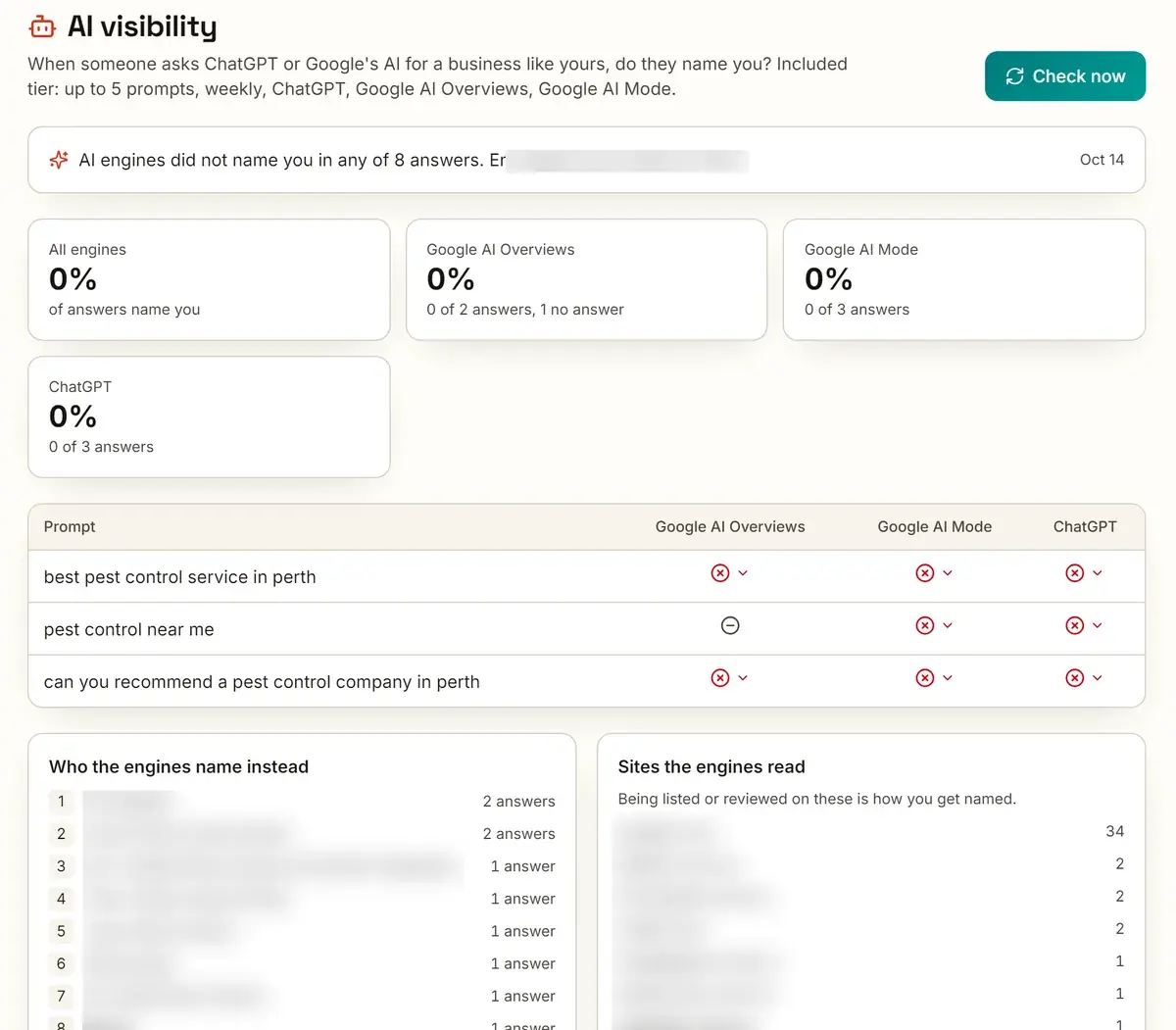
The engines did not invent those names. They read them from Google listings, from the competitors' own websites and from a Reddit thread where locals recommended companies. That is the whole lesson. The AI names the companies with the most reviews, the most listings and the clearest websites, which are the same companies that win the map pack. The audit's AI readiness section checks the part you control: whether the AI crawlers can read your site, whether your structured data points to your Google listing, and whether you are listed on Bing, which is where ChatGPT and Copilot look up local businesses.
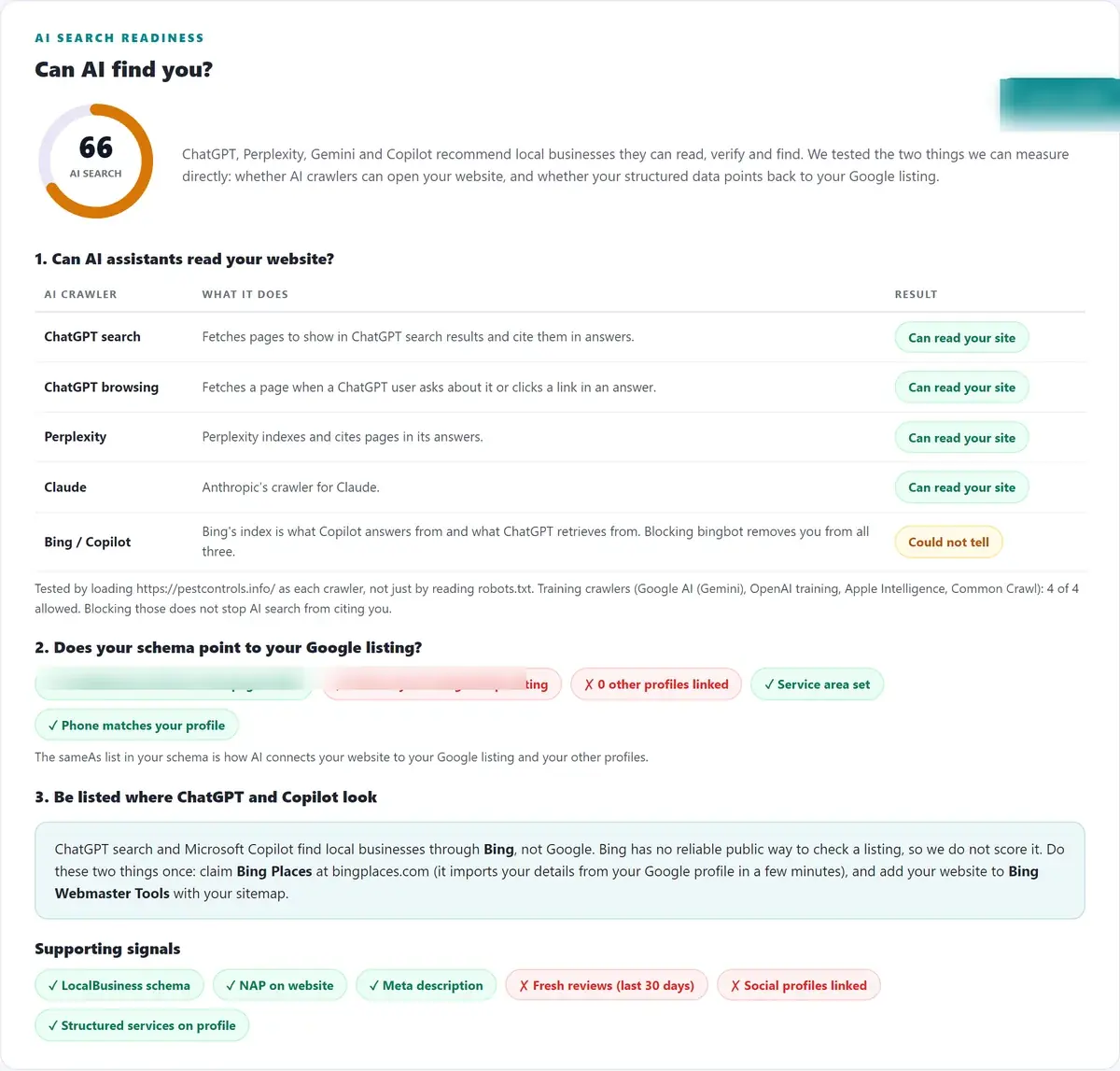
So "will AI replace pest control?" is the wrong question for an owner. The right one is whether AI will name you. The audit runs the check, and the fix list is the same list as the rest of this guide.
What to track every month
Four numbers, once a month, in a spreadsheet. Average map rank across the grid and the number of points in the top 3, from the same grid every time; the top 3 count is the one that predicts calls. Calls and direction requests from the profile, from the profile's own performance report. New reviews this month, yours and your three nearest rivals'. Pages indexed, from Search Console, so you know the pest and suburb pages have been found. Put a tracking phone number on the profile and a UTM tag on the website link, and in three months you will know what the map is worth in jobs, not just in ranks.
What pest control SEO costs, and whether to do it yourself
Published retainers for pest control SEO mostly sit between $1,500 and $3,500 a month, with budget providers around $500 to $600, and link building often billed separately at $500 to $1,500 a month on top. One roundup of vendor prices ranges from $750 to $5,000 a month depending on scope; another agency's guide notes that link building is frequently outside the base fee. The "$70 a month" packages people ask about buy a directory listing and a monthly report, not rankings.
An owner or office manager can do the profile, the service list, the photos, the review text and the pest pages. The parts that are hard to do yourself are measuring rank across the area every month, building citations in volume, and getting links from pest and suburb sites, which is what we sell by the link and by the scan rather than as a retainer; our plans list the prices. Whichever way you go, run the grid scan first so you have a day 0 to compare against.
How to choose a pest control SEO company
Four questions. How will you measure my rank? If the answer is one number from one spot, walk away. What do you build each month? Pages, listings, links, and where the links come from. How do you keep my phone and service areas consistent everywhere? They should be able to show the listings. Do you guarantee rankings? Nobody controls Google; that promise usually comes with a contract that is hard to leave.
If you run more than one yard
Each yard gets its own profile with its own service areas, its own phone number on its citations, its own suburb pages on the one website, and its own grid scan, because two yards ten miles apart show up on different maps. Pest pages are shared; suburb pages and suburb links are built per yard.
Pest control SEO mistakes we see most often

Measuring from the yard. "We rank 2nd for pest control" from your own driveway says nothing about the suburb eight miles out. Scan the grid.
One service area, nineteen empty slots. The profile allows 20. Most companies set one. Fill them with the suburbs you actually cover.
One services page covering every pest. Google will not rank you for termites without a termite page.
Twenty suburb pages that differ only by name. One real page per cluster beats twenty thin ones, and the thin ones get the site filtered.
Stale listings. The old company name or the old phone number on a directory quietly undercuts everything else. Fix before you build.
Asking for reviews once a year. Fifty reviews in one week after none for a year looks bought. A few a week, every week, looks like a busy company.
Stuffing the profile name. "Best Pest Control [City]" in the business name is a rule violation and the suspension costs more than any ranking it gains. Use the name on the truck.
A 90-day pest control SEO plan
Copy this into your notes. Each line is covered above.
Week 1: measure
Run a profile audit and a rank grid for "pest control [city]" and your best pest keyword
Note the suburbs showing 11 to 20 and which companies cover the most ground
Count the review pace gap: new reviews per month, you and the three nearest rivals
Weeks 2 to 4: foundation
Primary category Pest control service, every true secondary added, one service entry per pest and treatment
All 20 service areas set to the suburbs the trucks cover, address hidden, hours and emergency availability correct
Real photos uploaded, review link added to the invoice text, old listings corrected, citations built
Weeks 5 to 8: pages and niche links
One page per pest, starting with the ones whose peak month comes first
One honest page per suburb cluster, with jobs done there
Niche blog links to the pest pages, varied wording, spread over the month
Weeks 9 to 12: suburb links and re-measure
Suburb blog links pointed at the suburb pages, weighted to your weak rows on the grid
Bing Places claimed, structured data linked to the Google listing, AI check re-run
Re-run the same grid and compare top 3 points and local voice, not just average rank
See your own grid before the season starts
Scan "pest control near me" across your service area and see which suburbs you are missing. Then audit the profile and get the roadmap.
Questions people ask about pest control SEO
How do I get more pest control customers?
Most new pest control customers come from one of three places: someone searching Google Maps for a pest company near them, a referral from a neighbour, or a paid ad. The map is the cheapest of the three over a year, because you do not pay per call. To get more customers from it, make your Google Business Profile complete, ask every customer for a review after the job, list every pest you treat as a service, and build the listings and links that tell Google you serve the whole area and not just the street your yard is on. Then measure your map rank across the suburbs you drive to, not just at your own address.
What is the best advertising for pest control services?
For a company that wants steady calls at the lowest cost per job, ranking in the Google map pack beats every other channel we have seen, because the person searching already has a pest problem and is choosing who to call. Google Ads and Local Services Ads bring calls faster but stop the moment you stop paying, and pest control clicks are expensive. Door hangers and referrals still work for route-based companies. The combination most growing companies use is map ranking as the base, with ads switched on during the spring rush.
How much should I pay for local SEO?
Published retainers for pest control SEO mostly fall between about $1,500 and $3,500 a month, with budget providers around $500 to $600 and link building often billed on top at $500 to $1,500 a month. The number that matters more than the price is what you get for it each month: which pages are written, how many listings and links are built, and how your rankings are measured. We charge per link and per scan rather than a retainer, so a company can see the cost of each item. Whatever you pay, insist on a rank grid across your service area before and after, not a single ranking from one spot.
Is SEO better than Google Ads for pest control companies?
They do different jobs. Ads bring calls this week and cost more per call; pest control is one of the most expensive home-service categories to advertise in. SEO usually takes two to three months to show on the map across your area and then brings calls without a per-click cost. Most companies we work with run both at the start, then cut the ad budget back as the map rankings take over. Ads also hide a problem: if your profile and reviews are weak, the ad may get the click but the profile loses the call.
How long does pest control SEO take to work?
Profile fixes and a steady flow of new reviews can move your map rank within a few weeks. Links and new pages take longer, usually two to three months to show across the whole area, because Google has to find and index them first. In the example in this guide, the first clear move came at day 30 near the yard and the far suburbs moved most between day 60 and day 90. Start in the off-season so the work is in place before the spring rush.
Will AI replace pest control marketing?
AI is changing how people find a pest company, not whether they need one. When someone asks ChatGPT or Google AI Mode for a pest control company in their city, the AI names a handful of businesses, and it gets those names from directories, reviews and the websites it can read, not from your Google profile directly. In our check of one pest control business, the AI engines named it in 0 of 8 answers while naming competitors with more reviews and more listings. The same work that lifts your map rank is what gets you named by AI, so it is one job, not two.
What are the best keywords for pest control SEO?
Start with "pest control near me" and "exterminator near me", which together get around 250,000 US searches a month and always show a map. Then add the pests you treat as separate searches: termite inspection and termite control, bed bug treatment, rodent control, cockroach, ant, wasp and mosquito. Each has its own search volume and its own peak month, so each one deserves its own page on your website and its own service entry on your profile. Track three to five of them on a rank grid every month.
Why does my pest control company show up on Google in some suburbs but not others?
Google weighs how close the searcher is to your location, even when your address is hidden. Your company usually ranks well near the yard and fades in the suburbs you drive to. The way to rank further out is to give Google signals that tie you to those suburbs: the right service areas on your profile, reviews from customers who live there, a real page for that part of town, and links from sites about that area. A rank grid shows you exactly which suburbs are missing.