

A hailstorm hits on a Tuesday afternoon. By the next morning, thousands of homeowners affected by the storm are searching "roofers near me" on their phones. Google displays a map with three roofing businesses. Those three receive the majority of calls over the following month.
Roofing SEO is what gets you into those top three spots. It is not just about ranking near your own office, where you likely already appear, but also in the towns fifteen miles away where the storm caused damage. Most roofers miss out on jobs in those areas without realizing it, since their ranking tools only show results for a single location.
We create ranking software for local businesses, so this guide is based on what the map displays when you measure it accurately: using a grid that covers your entire service area. The guide includes the profile, website, reviews, and the three types of links. After that, it details a 90-day roofing campaign, showing the grid results at days 0, 30, 60, and 90, the 30 links added each month, and how each month’s work affected the map. All keyword numbers here use actual search data for the United States, collected in September 2026.
What is roofing SEO?
Roofing SEO involves making sure a roofing business appears on Google when people look for roof repair, replacement, or inspection services, showing up first in the map pack and then in the standard search results below. This includes managing your Google Business Profile, creating a separate website page for every service and each location you cover, collecting reviews, building business listings (citations), and obtaining links from other related websites.
For roofers, the map pack is the most important section. When a person types "roof repair near me," Google displays a map along with three business listings before any regular websites appear. If your business is in the map pack, you are likely to get the call. If you rank tenth further down the page, you usually receive little to no attention.
Why roofing SEO is different from other local SEO
A dental practice draws clients from the nearby area. Roofers, on the other hand, get business from any place a storm hits. That single difference affects nearly every aspect of SEO strategy for roofing companies.
Your service area is huge
Roofing contractors usually serve a city and the surrounding towns, typically within a 20 to 30 mile radius. Google’s map rankings are strongly influenced by the proximity between the searcher and each business, so a roofer will usually appear higher in searches close to their own location and drop off as the distance increases. The projects in those farther towns are legitimate work, but Google gives them to whichever business it sees as most relevant in that area.
Demand arrives in spikes
Storms cause a quick spike in demand in certain areas, but that demand only sticks around for a few weeks. You will not be able to boost your rankings in just three days after a hailstorm. You need to already have rankings in that city before the storm, or you will have to rely on ads and take your chances.
Every job is worth a lot
Check the cost per click for these keywords. On Google Ads, "storm damage roof repair" runs $47.01 per click. "Emergency roof repair" is $43.29, and "roof repair near me" costs $39.02. Advertisers spend this much since one roof replacement can bring in thousands. For roofers, this is why showing up in search results without paying for each click is especially valuable.
Most of the results come from businesses that are not local roofing companies
Lead generation websites, online directories, and storm response teams from other areas all target the same search queries. Many of these competitors have significant financial backing. What sets a local roofing business apart is their true local presence. The following approach focuses on demonstrating that authenticity to Google for each specific town.
How Google decides which roofers show up
Google bases local rankings mostly on three factors: relevance, distance, and prominence. Here is how each factor applies to a roofing business, explained simply.
Relevance measures how well your business fits what someone is searching for. Your main category, the services you list, the content on your website, and the language in your reviews all contribute to this. For example, a business set as a "Roofing contractor" with a dedicated page about storm damage repair on its site will be seen as more relevant for "storm damage roof repair" than a business that only has a general homepage.
Distance measures how close you are to the searcher or to the location they mention. Since your address is fixed, the other two factors become more important when targeting towns that are farther from you.
Prominence measures your reputation and visibility. It includes reviews, the number of sites that reference and link to your business, and the consistency of your business information online. Prominence allows a roofer to compete in a nearby town, even if it is not the closest one.
Combine these factors and you’ll notice a trend most roofers have without noticing: they show up well in their immediate area but are hardly seen farther out. The only way to spot this pattern is by tracking it with data.
Reading a roofing rank grid
A rank grid shows your map ranking for a single keyword from multiple spots throughout your service area. Rather than just seeing one rank like "you rank 4th," you receive a map that highlights where you are in the top 3, where you show up on page two, and where you are missing entirely.
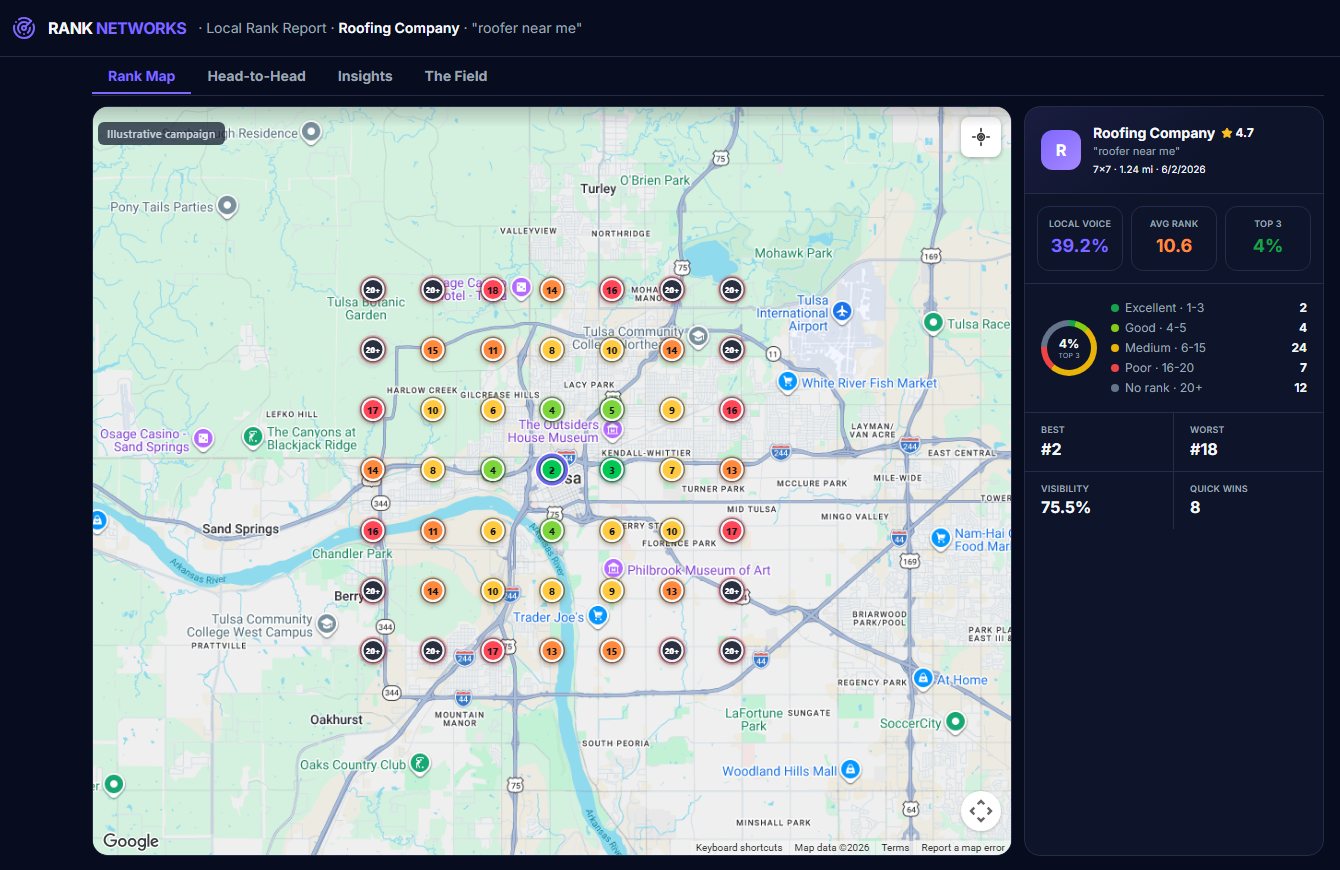
This is how you interpret the map. The pin at the center marks the business location. The numbers nearby are lower, which is positive, and they increase as you move outward. In the corners, you see "20+", indicating the business does not rank in the top 20 results in those spots. Homeowners in those areas will not see the business in their search results.
Take a look at the scores on the right. Average rank 10.6 might make it seem like the business is performing well. However, average rank only measures the locations where the business actually appears. The real indicator is visibility: 75.5%. This roofer does not appear on the map in a quarter of its own city. It only ranks in the top 3 for 4% of the grid.
The local voice score (39.2% in this case) merges both factors into a single number: each spot where your business ranks adds to your score based on your position, while any spot where you are absent adds nothing. This is the best single metric for monitoring a roofer’s progress over time, since it only increases when you achieve higher rankings in more areas.
You can set up a grid for your business in just a few minutes using our free Google Maps rank tracker. Try it with your top two searches, which are often "roof repair" and "roof replacement" along with your main city.
Roofing keywords that actually bring jobs
Before updating your profile or website, first choose the keywords you want to target. The following are actual monthly search volumes from the United States, along with a ranking difficulty score from 0 to 100 (lower scores mean it is easier to rank) and the cost per click that advertisers pay:
| Search | Monthly searches | Difficulty | Cost per click |
|---|---|---|---|
| roofers near me | 165,000 | 26 | $24.77 |
| roofing company | 110,000 | 2 | $23.03 |
| roof repair near me | 90,500 | 12 | $39.02 |
| roof repair | 74,000 | 7 | $40.95 |
| roofing contractors near me | 40,500 | 28 | $20.90 |
| roof leak repair | 33,100 | 2 | $34.77 |
| roof inspection | 33,100 | 6 | $34.78 |
| roof replacement | 33,100 | 48 | $30.63 |
| roof replacement cost | 18,100 | 25 | $19.96 |
| new roof cost | 9,900 | 10 | $18.02 |
| emergency roof repair | 8,100 | 0 | $43.29 |
| hail damage roof | 5,400 | 7 | $19.02 |
| flat roof repair | 4,400 | 0 | $32.58 |
| storm damage roof repair | 3,600 | 0 | $47.01 |
| commercial roofing contractors | 3,600 | 4 | $27.34 |
| roof insurance claim | 1,000 | 3 | $23.36 |
United States, monthly averages, September 2026. National totals: your own town is a small slice of these.
What this table tells a roofer
Most "near me" searches are dominated by the map pack results. A blog post will not help you rank for "roofers near me." To show up there, you need to focus on your business profile, customer reviews, and the local ranking factors we discuss below.
The most notable keywords appear lower in the list. "Emergency roof repair" (8,100 a month, difficulty 0, $43.29 a click) and "storm damage roof repair" (3,600, difficulty 0, $47.01) both have high advertising costs but are simple to rank for. If a roofer creates a truly helpful page for each topic and supports it with strong local signals, they will be targeting areas where most competitors are not.
Organize your keyword list into three groups. Start with your main services like repair, replacement, inspection, and leak repair. Next, add urgent needs such as emergency, storm damage, and hail damage. Finally, include the specialized jobs you handle, like flat roofs, metal roofs, or commercial roofing. Do not include keywords for services you do not offer. There is no benefit to ranking for "metal roofing contractors" if you do not provide metal roof installation.
Your Google Business Profile, set up for roofing
Your profile is the most important factor for the map pack, and nearly all of it costs nothing. Work through these steps in sequence.
Category
Set your primary category to Roofing contractor. Add secondary categories only for work you really do, like gutter services or siding. Search your main keyword in your city and look at the categories the top 3 use. If every winner uses the same primary category and you do not, that is your first fix.
Service areas
If clients do not visit your office, you should set your business as a service area business and include the towns you serve. Google allows you to list as many as 20 service areas, and they recommend these areas remain within roughly a two-hour drive from your main location. Adding a town in this section does not automatically improve your ranking there, but it does inform Google about your service locations and should be consistent with your other business information.
Photos from real jobs
Post pictures taken directly from your roofing jobs, including your team and truck when you can. Photos showing the roof before and after a storm repair work best. Using stock images is ineffective, and if your profile has not had any photo updates in a year, it will seem neglected to customers who are comparing several roofing companies.
Services and posts
Make a list of all your services with simple, clear descriptions. After a storm, write a Google post offering storm damage inspections in the towns that were hit. This keeps your profile updated and gives people looking at different roofers a reason to contact you.
To compare your entire profile with the roofers who rank above you, use our 21-point local SEO audit checklist for a step-by-step review of each item.
Service pages and town pages
Nearly all roofing websites fall into the same trap: they create a single "Service Areas" page that simply lists twenty towns. Google treats this as just a list, not as evidence that your business actually operates in those locations.
One page per service
Create a separate page for every primary service: roof repair, roof replacement, roof inspection, storm damage repair, and emergency roof repair. On each page, describe the service in terms homeowners will understand, outline the typical process, explain how insurance applies if relevant, and include instructions for scheduling. Use a page title that clearly states the service and your main city, such as "Storm Damage Roof Repair in [City] | [Company]".
One real page per important town
Create a separate page for every key town. Make sure each page truly focuses on that specific town: mention projects you have completed locally, describe the roofing styles typical in the area, explain your response times, and include testimonials from residents. Only make a page for a town if you can make it unique from the others.
Do not build doorway pages
Twenty copies of the same page with the town name swapped are what Google calls doorway pages, and it filters them out. Worse, a pile of thin duplicates can drag down the whole site. Build fewer, better town pages: five genuinely useful ones beat forty copies.
Your city-specific links need to direct to these town pages, which is key for ranking well near the outer parts of your service area. I’ll explain more about this later.
Reviews that help you rank
Reviews boost your visibility, and the language customers use in them adds to your relevance. For example, if someone writes, "they fixed our hail damage in [town] within two days," it benefits you for both hail damage and that specific town. While you cannot write reviews on behalf of your customers, you can make the process simple for them and encourage honest, specific feedback.
Pick the right time to ask. For roofers, the best moment is just after the final walkthrough, while the homeowner is still outside seeing the completed roof. That evening, send a text message with a direct link to your review form. If you wait a week, most customers will not respond.
Request that the customer specify the service you provided. You can say something like, "It would really help if you mentioned the repair we did." Do not offer discounts or gifts in exchange for reviews, as this goes against Google's policies. It is also against the rules to only request reviews from satisfied customers while excluding others.
Respond to all reviews. Pay special attention to negative feedback. When you answer a complaint with a clear and calm response, it reassures future homeowners more than a handful of five-star ratings, because it demonstrates how you handle problems when something does not go as planned.
Citations, niche blogs and city blogs: the three links that move a map
Profiles and pages establish your relevance. Links and listings build your prominence. For a roofer, these three types serve different purposes, and the sequence you create them in is important.
1. Citations: make every signal agree
A citation means your business name, address, and phone number appear on an external website, such as a local directory, trade directory, or map service. Citations by themselves rarely move a roofer higher in the map results. Their main purpose is to keep your information consistent. If one directory lists an outdated phone number and another spells your company name wrong, Google becomes less confident that these listings belong to the same business, which weakens all the other signals you create.
Start by creating citations, and make sure to correct any that are inconsistent before moving on.
2. Niche blogs: show you are an expert in roofing
Niche blog links are posts on websites related to roofing, home improvement, and construction that include links to your service pages. These links show Google that industry-specific sites support your business, helping to increase your relevance for roofing-related searches.
The anchor text in your links is important. Use a mix that includes your brand name, generic terms such as "this roofing company," and service-specific phrases like "storm damage roof repair." If all your links use "best roofer," your profile can appear artificial.
3. City blogs: show up in more distant towns
City blog links are posts published on websites focused on a certain city or region, and they include a link to your page for that location. These links help you reach the outer areas of your grid. Getting a link from a website dedicated to a specific town sends a clear message that your business matters in that area, not only where you are physically located.
If you are a roofer covering a large region, city-focused blog posts that link to your actual town pages are often the quickest method to turn those grey "20+" markers into real rankings.
Case study: a roofer's map from day 0 to day 90
Illustrative campaign, built from how we run roofing campaigns. Scores are calculated by the Grid Ranker.
That covers the theory. Here’s how it plays out step by step: a single roofing company in one city, building 30 links each month over three months, with the same 49 points checked every 30 days. Focus on the outer areas of the map instead of the center.
Visibility
75.5%
100%
Day 0 to day 90
Local voice
39.2%
71.7%
Day 0 to day 90
Top 3 points
2 of 49
9 of 49
Day 0 to day 90
Not ranking
12 points
0 points
Day 0 to day 90
"roofer near me": the same 49 points, every 30 days
IllustrativeDay 0
June 1
Before any work
- Visibility
- 75.5%
- Local voice
- 39.2%
- Top 3 points
- 2
- Not ranking
- 12
Day 30
July 1
After citations + niche blogs
- Visibility
- 77.6%
- Local voice
- 46.2%
- Top 3 points
- 5
- Not ranking
- 11
Day 60
July 31
After niche + hyperlocal
- Visibility
- 95.9%
- Local voice
- 57.7%
- Top 3 points
- 7
- Not ranking
- 2
Day 90
August 30
After citations + hyperlocal
- Visibility
- 100%
- Local voice
- 71.7%
- Top 3 points
- 9
- Not ranking
- 0
Before: where the roofer was losing jobs
The business
Illustrative- Business
- Residential roofing company, 3 crews
- Market
- One city. Every link and page targets that city only
- Starting reviews
- 60 reviews at 4.7
- Leaders in the area
- About 145 reviews on average
- Website
- Homepage and one general services page, no city page
- Tracked search
- "roofer near me", 7 by 7 grid, points about 1.2 miles apart
On paper this roofer was doing fine. Good rating, complete profile, ranking 2nd from its own address. Ask the owner and they would say SEO was working. Then the first grid came back.
12 out of 49 locations displayed "20+". In one-fourth of its home city, someone looking up "roofer near me" would have to go past twenty other roofers before finding this business. Just 2 locations appeared in the top 3, and both were right next to the company. When you include the missing locations as 21, the average for the outer ring comes to 18.2, which, for a roofing company, is basically invisible.
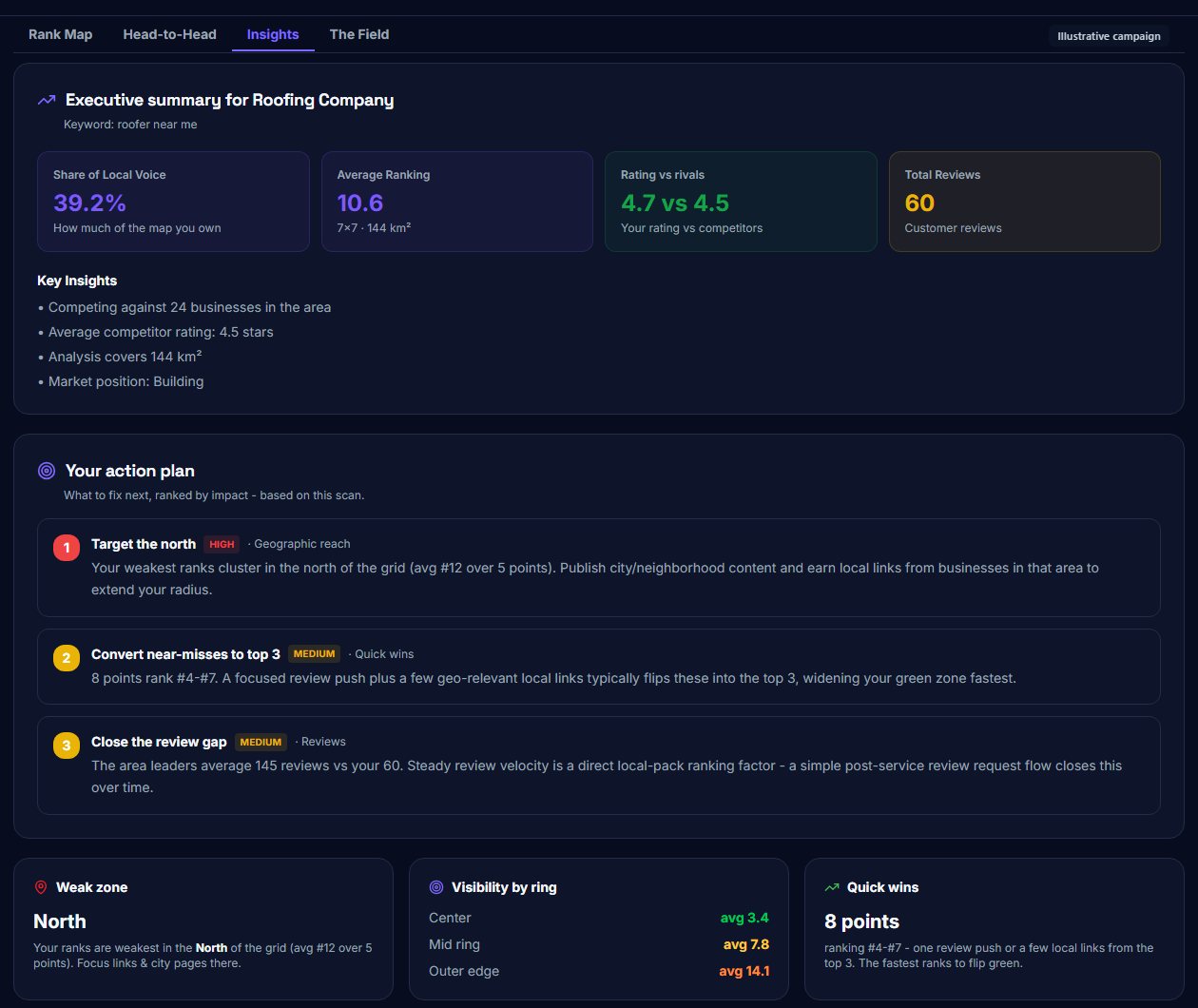
The day 0 scan gave three problems to fix, in this order:
1. The north side of the city underperformed. It ranked an average of 12th across 5 locations, and there was no content on the website or elsewhere online that connected the business to those areas.
2. 8 near misses. These were points that finished between 4th and 7th place, just short of making the top 3.
3. A review gap. The roofers leading the area averaged about 145 reviews against this one's 60. Links alone would not close that, so review requests ran from day 1.
The 90-day action plan: citations, niche blogs, hyperlocal
The strategy called for 30 links per month, totaling 90, divided equally among the three types of links. Each month focused on two types, with each round building on the previous work. Since the business operates in a single city, all citations, hyperlocal articles, and the new city page targeted that one location. No links went to other towns.
The 90-day action plan: 30 links a month, 90 in total
IllustrativeMonth 1 · Days 1 to 30
Citations + niche blogs
Make the listing consistent and prove roofing relevance
- 2 old listings with a dead phone number fixed first
- 15 citations on local, trade and map directories, all with the exact same name, address and phone
- 15 niche blog articles on roofing and home improvement sites
- Niche links to storm damage repair (5), roof replacement (5) and roof repair (5)
Links point at: Homepage and the three main service pages
What moved: 36 of 49 points improved. The rings within 2.5 miles moved most, and top 3 went from 2 points to 5.
Month 2 · Days 31 to 60
Niche blogs + hyperlocal
Keep building relevance and tie the business to its city
- 15 more niche articles, to emergency roof repair (5), roof inspection (5) and storm damage repair (5)
- 15 hyperlocal articles on sites about the same city
- Hyperlocal topics weighted to the north side neighborhoods flagged on day 0
- Link wording mixed: brand name, brand plus city, plain phrases
Links point at: Service pages and the new city page
What moved: 9 points that had never ranked started ranking. Visibility went from 77.6% to 95.9%.
Month 3 · Days 61 to 90
Citations + hyperlocal
Win the outer neighborhoods of the city
- 15 more citations on city directories, community sites and trade associations
- 15 more hyperlocal articles on sites about the same city
- Topics covering the neighborhoods at the edge of the grid
- Each article links to the city page or the storm damage page
Links point at: City page and storm damage page
What moved: The outer edge. Its average went from 14.0 to 9.8, and the last 2 grey points started ranking.
Month 1: 15 citations and 15 niche blog posts (days 1 to 30)
We started by cleaning up old information. Two directories showed a phone number the company no longer used, so we corrected those before adding anything new. After that, we published 15 citations on local, industry, and map directories, making sure each one matched the name, address, and phone number listed on the Google Business Profile.
At the same time, 15 specialized blog posts were published on roofing and home improvement websites: 5 directed to the storm damage repair page, 5 to roof replacement, and 5 to roof repair. The site received a dedicated city page featuring actual completed projects from the area and testimonials from local clients. Crew leads also began sending a review link by text to customers after each job was completed.
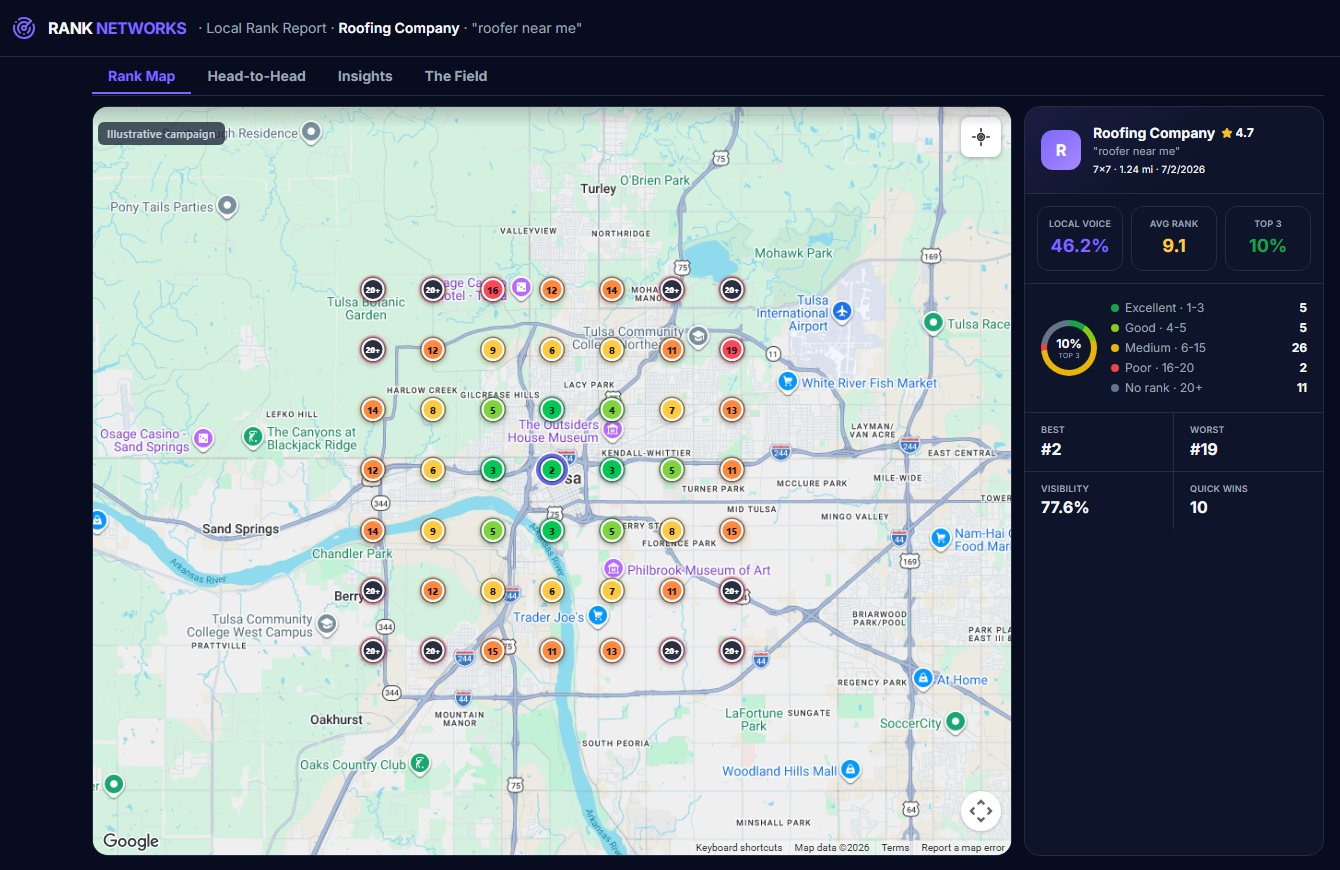
Day 30 result: the center area saw gains. Out of 49 points, 36 showed improvement. Local voice increased from 39.2% to 46.2%, and the top 3 rose from 2 points to 5. The area roughly 2.5 miles away had the biggest jump, going from 10.4 to 8.3. Steady citation work and relevant links from industry-specific sites helped the business become a stronger local option.
There was little change at the margins. Visibility increased just slightly, from 75.5% to 77.6%, and 11 positions remained grey. Niche links communicate "this is a quality roofer," but they do not indicate "this roofer serves the north side of the city." To address that, hyperlocal links were necessary.
Month 2: 15 industry-specific blogs and 15 hyperlocal posts (days 31 to 60)
In month 2, we maintained relevance by adding 15 additional niche articles: 5 linked to the emergency roof repair page, 5 to roof inspection, and 5 to storm damage repair. By targeting different service pages, we connected the business to a wider range of homeowner search queries.
The remaining 15 links were hyperlocal, coming from articles on websites focused on the same city and directed to the new city page. These articles mostly covered neighborhoods on the north side, which day 0 identified as the area needing the most improvement. The anchor text varied, using the brand name alone, the brand name with the city, and some generic terms.
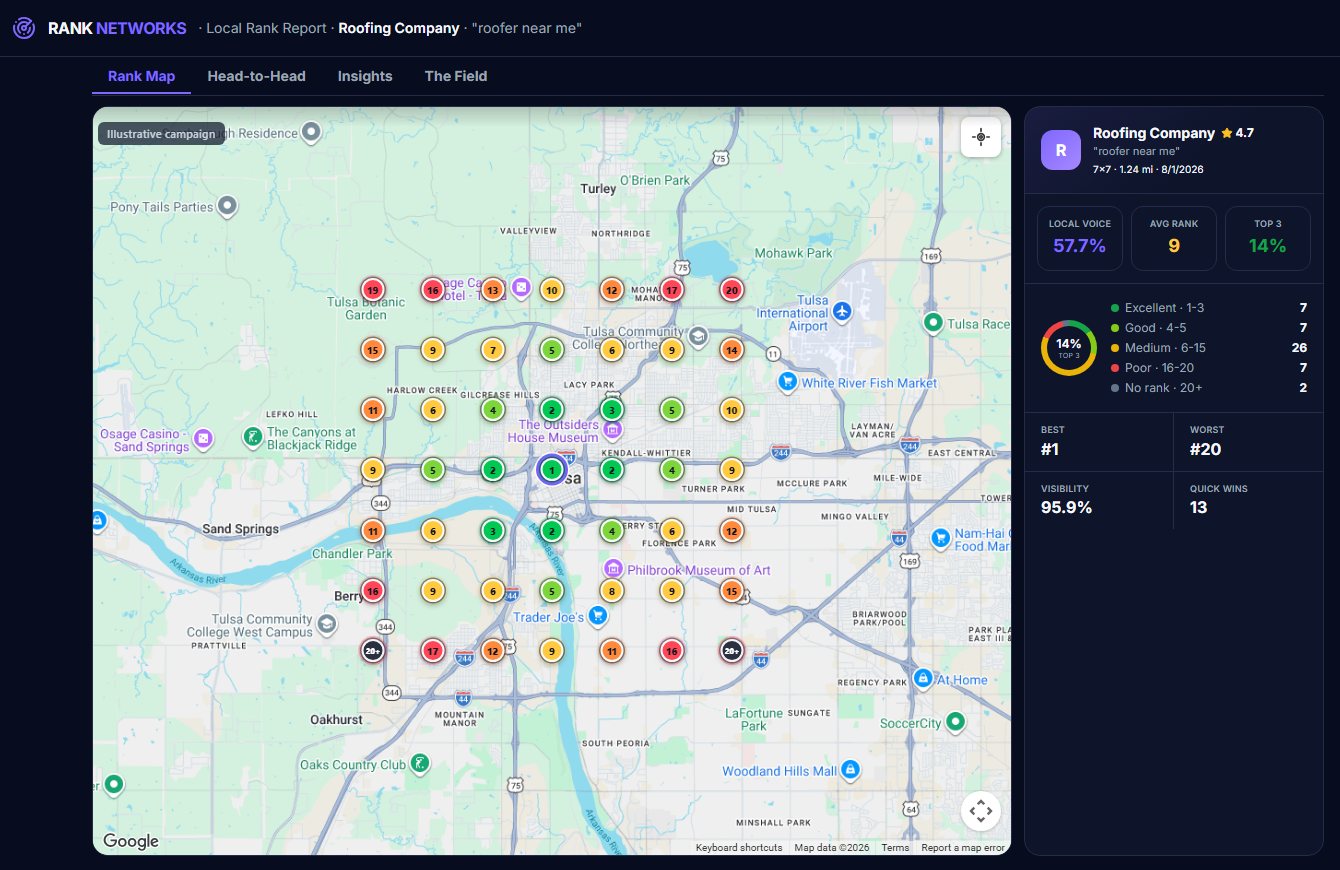
Day 60 result: the grey points begin to disappear. 9 points that previously had no rankings began to show up, and visibility increased from 77.6% to 95.9%. The outer ring score went from 17.1 down to 14.0. Local voice rose to 57.7%, the top 3 rankings expanded to 7 points, and the business moved into the number 1 spot at its own address.
Not all positions increased. A point just southeast of the business dropped from 7th to 8th place. This kind of change is typical between scans, which is why you should evaluate a campaign based on the entire grid, not just a single spot.
Month 3: 15 citations and 15 hyperlocal listings (days 61 to 90)
Last month we focused on the outer neighborhoods. We published 15 additional citations, placing them on city directories, local community websites, and trade association pages that are tied to the city. Another 15 hyperlocal articles highlighted the neighborhoods on the outskirts, each one linking back to either the city page or the storm damage page.
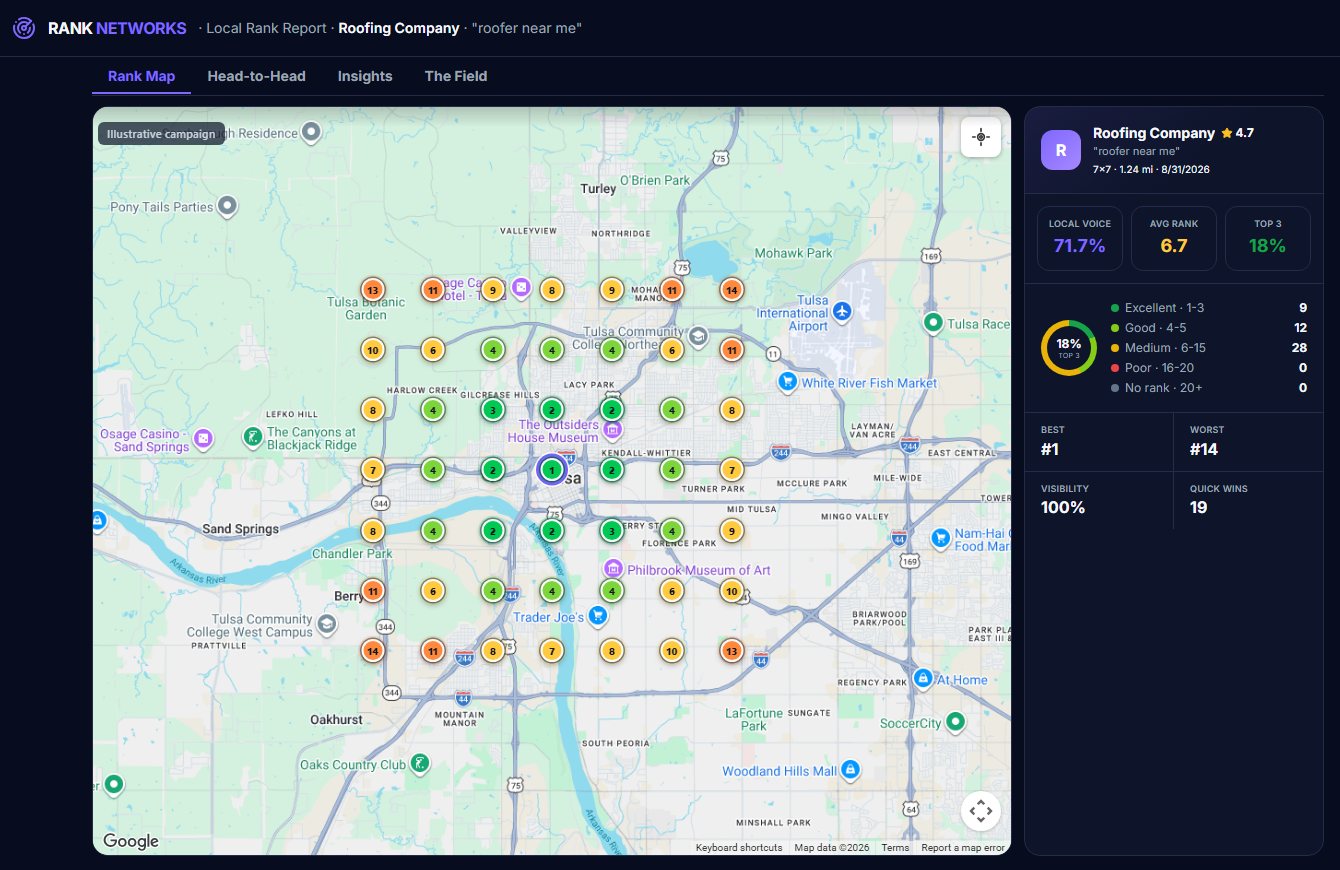
Day 90 result: the edges fill in. The last 2 grey points started ranking, so visibility hit 100%. The outer ring average dropped from 14.0 to 9.8, the biggest change of the whole campaign, in exactly the part of the city the hyperlocal links and city citations were aimed at. Points in the top 10 went from 30 to 40, and local voice finished at 71.7%.
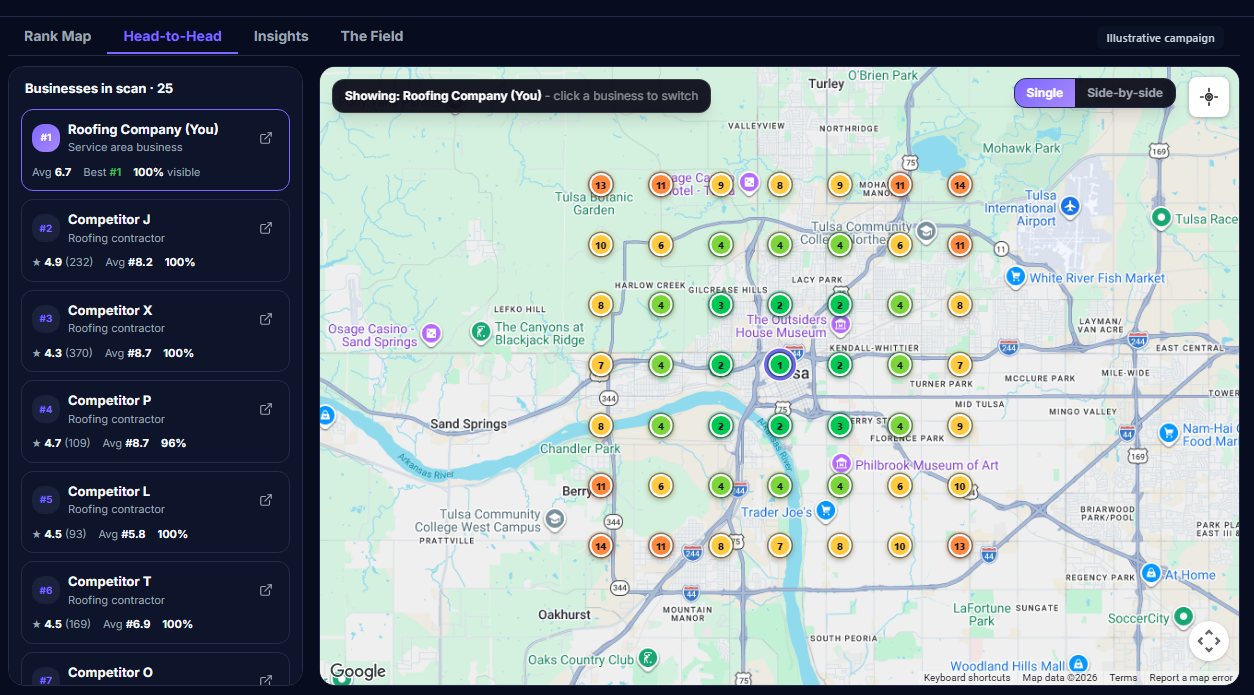
Results after 90 days
Results after 90 days, scan by scan
Illustrative| Metric | Day 0 | Day 30 | Day 60 | Day 90 |
|---|---|---|---|---|
| Local voice | 39.2% | 46.2% | 57.7% | 71.7% |
| Visibility | 75.5% | 77.6% | 95.9% | 100% |
| Points in the top 3 | 2 | 5 | 7 | 9 |
| Points in the top 10 | 19 | 21 | 30 | 40 |
| Points not in the top 20 | 12 | 11 | 2 | 0 |
| Average rank where it ranks | 10.6 | 9.1 | 9 | 6.7 |
| Outer edge average (20+ as 21) | 18.2 | 17.1 | 14 | 9.8 |
| Google reviews | 60 | 68 | 77 | 86 |
Scores at each scan
IllustrativeThere are two main points. The largest increase in visibility happened during month 2, which was the first month hyperlocal links were added. Before this, the business improved in areas where it already ranked but did not show up in new locations. Also, local voice increased each month, since it only goes up when the business ranks higher in more locations. Because of this, local voice is a more useful metric to report than visibility by itself.
Average rank by distance from the business (lower is better)
IllustrativeCenter
About 1.2 mi out
About 2.5 mi out
Outer edge, 3.7 mi+
This breakdown shows exactly how each month contributed. In Month 1, we focused on citations and niche blogs, which shifted rankings within a 2.5-mile radius. During Month 2, we used niche and hyperlocal strategies to keep progress going in the center and began making changes at the outer edge. Month 3 targeted citations and hyperlocal links, mainly affecting the outermost ring, which includes the neighborhoods farthest from the business. In practice, the impact overlaps because links continue to be discovered and indexed after their creation, but each monthly approach had a specific purpose.
What changed at each point, day 0 to day 90
Illustrative49 of 49
points ranked higher on day 90 than on day 0.
12 points went from not ranking at all to ranking, all of them on the outer ring of the city.
The center moved one place (2nd to 1st). It was already strong, so almost all of the gain is away from the office.
Between day 30 and day 60, one point just south-east of the business slipped from 7th to 8th. Small swings like that are normal from scan to scan.
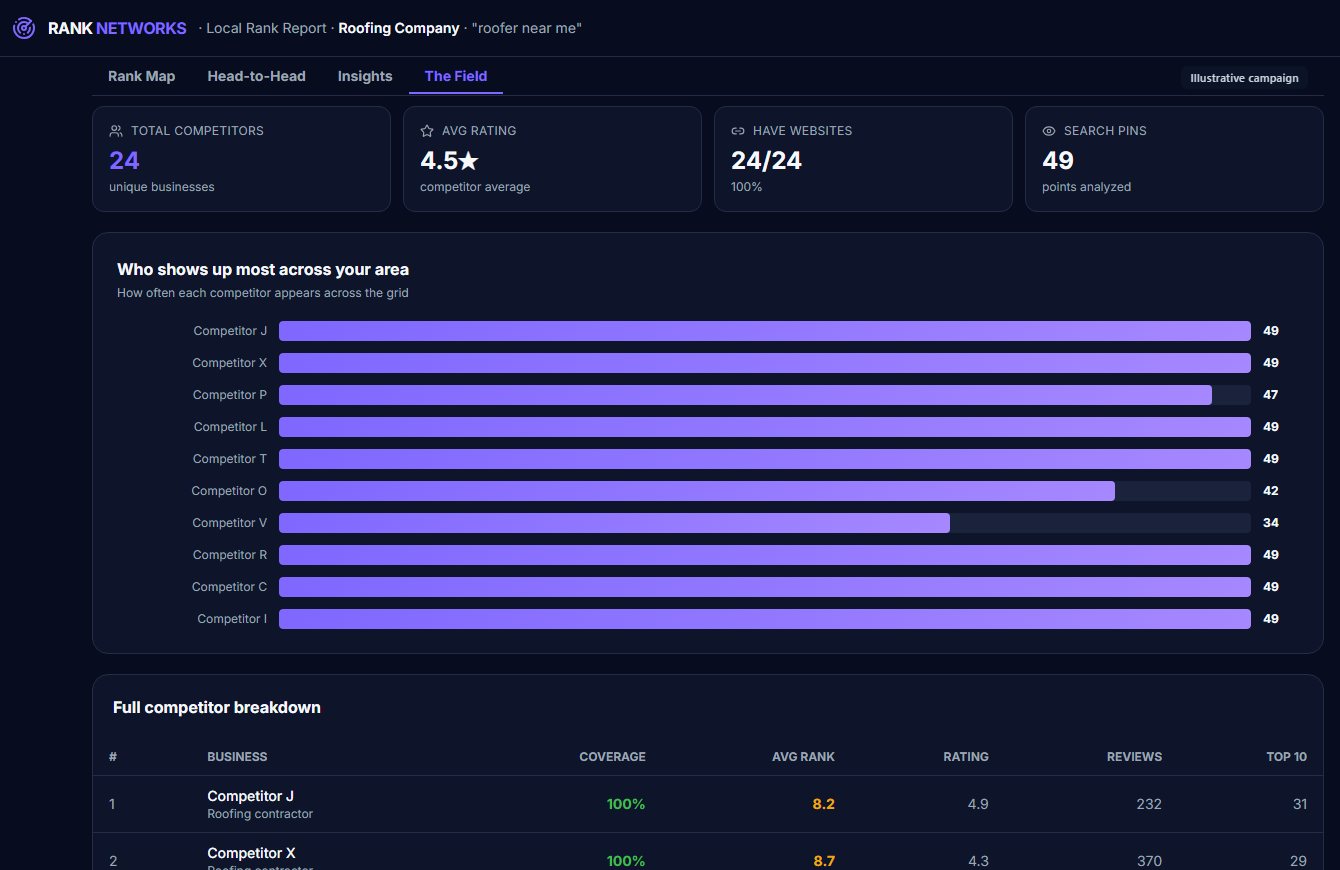
A quick note about average rank: it was 10.6 on day 0 and improved to 6.7 by day 90. This shift might seem small, but it actually reflects a significant impact for the business. The day 0 average did not include the 12 keywords where the roofer had no ranking. This is a key reason why average rank alone does not give the full picture for a roofing campaign.
What this case study teaches
Check before starting your build. The initial grid on day 0 determined the first placements for hyperlocal links.
Match link types to the task. Citations help keep your listings uniform, niche blogs add authority in roofing, and hyperlocal links target neighborhoods in your city where your business is not yet visible.
Focus on your own city. If you are a roofer serving just one city, you do not need links from other towns. You need links from every neighborhood within your city pointing to your business.
Continue gathering reviews. The roofer increased their reviews from 60 to 86 during the 90-day period. They remain behind the top competitors, so review requests will remain part of the strategy for the upcoming quarter.
Real campaigns vary
Real grids go up and down between scans, competitors run their own campaigns, and results depend on how crowded your city is. Use the order and the way of measuring from this campaign, not the exact numbers.
See where your roofing company disappears
Run a map grid for "roof repair" in your city and see every point where you rank, where you slip, and which roofers are taking the calls in the towns further out.
Timing roofing SEO around storm season
Starting roofing SEO right after a major storm is too late. At that point, homeowners are already calling the roofers who were ranking in those areas before the storm hit.
It takes time for rankings based on links to show up, since Google needs to discover and add new links to its index first. Work backwards from your busiest time of year. If hail and storm season hits its peak in late spring where you are, make sure your town pages and citations are finished before winter ends, and have your city blog links published at least a couple of months ahead of the peak season.
If a storm comes through, focus on updating your profile instead of building links. Share posts about storm inspections in the impacted towns, double-check that your hours and phone number are accurate, and respond quickly to all new reviews. These updates can make a difference in just a few days.
What is the 25% rule for roofing? (And content homeowners search for)
The 25% rule is a building code requirement most commonly associated with Florida. According to Section 706.1.1 of the Florida Building Code, Existing Building, you cannot repair, replace, or recover more than 25 percent of a roof or any roof section within a 12-month period unless you update the entire roof or section to comply with the current code. In 2022, Florida updated this rule for roofs constructed, repaired, or replaced under the 2007 Florida Building Code or after: now, only the specific area being repaired or replaced must meet current code requirements.
You’ll find it in Google’s "People also ask" section when searching about roofing. This means homeowners look up insurance and building code topics before reaching out to a roofer. When someone is debating with their insurance company about getting a full replacement, that’s the type of client roofers want to attract.
These types of questions are among the most valuable content a roofing business can share. A straightforward page explaining partial replacement procedures in your state, typical steps for insurance claims, what happens during a storm inspection, or the lifespan of a shingle roof in your area addresses the real concerns your customers have. This content encourages other websites to link to you and provides reliable information for AI-generated answers. Make sure to verify the regulations for your specific state, as partial replacement guidelines differ.
The same three-link structure works for other trades. The pest control guide shows it for a service-area business with a hidden address, and the dentist guide for a business customers visit.
Is roofing SEO still worth it with AI search?
For keywords that bring in revenue, the answer is yes. If a person searches for "roof repair near me," they are likely looking to hire a roofer right away, and Google continues to show a map with local businesses for those queries. AI-generated responses usually show up for general questions such as "how long does a metal roof last."
Those research questions remain important, but their role has shifted. AI-generated answers usually rely on pages that are straightforward, detailed, and credible. If a roofing company lays out the 25% rule, storm claims, and roof lifespan information clearly on its own website, it is creating the type of content that AI tends to reference. The homeowner who sees that answer will still look for a local roofer, which means the map listings are still crucial.
Roofing SEO yourself, or hire a roofing SEO company?
There is quite a bit you can handle on your own. Setting up your profile, adding job photos, asking for reviews, creating service pages, and building a few genuine town pages mostly take your time rather than any advanced tools. If you put in a few hours each month on these tasks, you will typically outperform competitors who ignore them.
The challenging aspects by yourself are those that require data or larger scale, like tracking rankings throughout your entire service area instead of just a single device, regularly adding citations to multiple directories, and getting links from roofing and local city websites.
What to pay
Most local SEO retainers typically cost anywhere from several hundred to several thousand dollars each month. The monthly price alone does not reveal much. What is important is what you actually receive: the number of citations and links, the specific pages created, the towns targeted, and how outcomes are tracked. If an agency cannot provide those details in writing, you are only buying a vague assurance. Our pricing is based on each link and each scan, so you always know exactly what you are getting each month.
How to choose a roofing SEO company
Ask four questions before you sign anything:
How will you measure my rankings? If they give you a single number from one spot, that is not enough. You need to see a grid that covers your entire service area. What exactly do you build each month? Ask for details about pages, citations, links, and the sources of those links. How do you handle multiple towns? If their plan is to make forty nearly identical pages, that is a red flag. Do you guarantee rankings? No one has control over Google. Guarantees usually come with a long contract, not real results.
Roofing SEO mistakes we see most often
Measuring success by a single ranking. When the owner says, "We rank 3rd for roof repair," it does not reflect results in the areas affected by storms. Check the full grid.
One "Service Areas" page by itself. Simply listing towns does not count as a ranking signal. You need an actual page for each key town.
Mismatched business details. Outdated phone numbers and addresses listed in directories quietly undermine all your other efforts. Update these before adding anything new.
Starting in storm season. Build months before the peak, not during it.
Keyword stuffing the business name. Including phrases like "Best Roofer Dallas" in your profile name goes against Google's guidelines. This can lead to your profile being suspended, which is a much bigger problem than dropping a few spots in the rankings.
Links that all use identical wording. When each link pointing to your site repeats the same phrase, like "roofing company in [city]", it appears artificial instead of natural. Include your brand and use simple terms to vary your links.
A 90-day roofing SEO plan
Add this to your notes. Every point listed above is addressed.
Week 1: measure
Run a rank grid for your two most valuable searches in your main city
Note the towns showing 20+ and which competitors cover the most ground
Pick the 5 towns you most want jobs from
Weeks 2 to 4: foundation
Primary category set to Roofing contractor, service areas listed
Job photos uploaded, every service listed on the profile
Business details fixed on every directory, citations built
Review requests sent the evening of every finished job
Weeks 5 to 8: pages and niche links
One page per main service, including emergency and storm damage repair
One genuinely different page for each of your 5 towns
Niche blog links to service pages, varied wording, spread over the month
Weeks 9 to 12: city links and re-measure
City blog links pointed at each town page
One helpful page on a question homeowners ask, such as partial replacement or insurance claims
Re-run the same grid and compare visibility and local voice, not just average rank
Questions people ask
What is roofing SEO?
Roofing SEO involves helping a roofing business appear in Google results when people look for roof repair, replacement, or inspection services. This includes both the map pack and the standard search listings underneath. The map pack is usually the top priority for roofers, since searches for terms like "roofers near me" or "roof repair near me" bring up a map as the first result. Roofing SEO includes optimizing your Google Business Profile, creating service and location pages on your website, managing reviews, building citations, and earning links.
How much should a roofing company pay for SEO?
Most local SEO retainers cost anywhere from several hundred to several thousand dollars per month, but the fee itself does not reveal much about what you will receive. Request a breakdown: find out which pages will be created, the number of citations and links included, the towns being focused on, and the way rankings are tracked. Roofers can also divide the tasks, managing profiles and reviews internally while outsourcing only the tasks that require specialized tools or access to a link network.
How long does roofing SEO take to work?
Updating your profile and getting fresh reviews can shift your map rankings in just a few weeks. Building links and adding new town pages often need two to three months before you see results across your full service area, since Google must first discover and index those links. This is why roofers should begin these efforts ahead of storm season, not wait until it starts.
What is the 25% rule for roofing?
Florida is the most recognized example. According to the Florida Building Code, Existing Building, Section 706.1.1, you cannot repair, replace, or recover more than 25 percent of a roof or roof section within any 12-month period unless you update the entire roof or section to meet the current code. A law passed in Florida in 2022 adjusted this rule for roofs constructed, repaired, or replaced under the 2007 Florida Building Code or newer: for these roofs, only the area being repaired or replaced must comply with the current code. Other states have their own rules for partial roof replacement, so always review your local building code.
Can I do SEO for my roofing company myself?
Most of it can be handled by the owner. Setting up the Google Business Profile, uploading job photos, asking for reviews, and creating a page for every main town and service are all tasks you can do yourself without extra software. The tougher parts to manage on your own are tracking rankings throughout your service area, creating citations in large numbers, and getting links from sites that matter.
Is SEO still worth it for roofers now that Google shows AI answers?
Yes, for searches where people are looking to hire, like "roof repair near me," Google continues to show local business maps so customers can find and contact a roofer. AI-generated answers mainly show up for wider questions such as "how long does a roof last." It is still important to have those topics on your website, since Google’s AI pulls information from pages that are already established and credible.
What is the best way to advertise my roofing company?
The majority of top-performing roofing businesses use several channels at once: they get leads from the Google map pack using SEO, run paid search or local service ads to generate quick calls, and rely on referrals from previous clients and insurance adjusters. SEO takes the longest to gain traction but delivers the lowest cost per job over time since you do not pay for each click. Paid ads help fill the gap while SEO ramps up and are also valuable when storms drive up demand.
How do I choose a roofing SEO company?
Request to view rankings shown on a map grid covering your whole service area, not just a single ranking figure. Find out what specific work is completed each month and the sources of any links they build. Ask how they manage targeting several towns without making thin or duplicate content pages. Be cautious with companies offering guaranteed rankings; no one can control Google, and these promises often come with contracts that are difficult to exit.
Why does my roofing company show up in some towns but not others?
Google bases rankings partly on the searcher’s location. Distance from the person searching is a key factor for local results, so a roofer will typically appear higher near their business address and drop off farther away. To show up in searches for more distant towns, the business needs to build connections to those places. That means having a dedicated page for each town, getting reviews from customers in those areas, and earning links from local websites.